
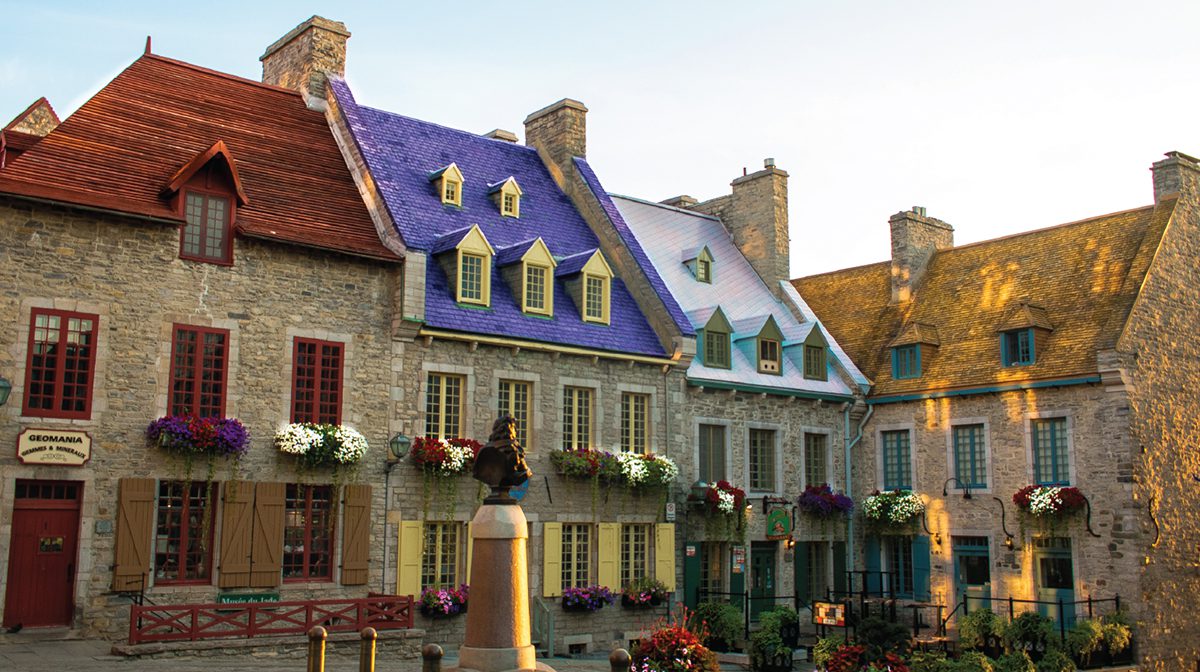
 What makes an entire city worthy of preservation for all humanity? In most places, history is carefully protected behind museum glass or within isolated monuments. In Old Québec, history remains alive. It unfolds along narrow cobblestone streets, within centuries-old stone buildings, behind fortified walls, and across sweeping viewpoints overlooking the St. Lawrence River. This extraordinary connection between the past and present is why UNESCO recognized the Historic District of Old Québec as a World Heritage Site in 1985, preserving one of the finest examples of a fortified colonial city north of Mexico.
The designation was not based on a single attraction. UNESCO honored Old Québec as a complete historic urban landscape, where architecture, streetscapes, fortifications, and cultural traditions together tell the story of centuries of history. Founded in 1608 by Samuel de Champlain, Québec became the heart of New France and one of the most important settlements in North America. Its location atop Cap Diamant gave it strategic importance, while its distinctive French character shaped the city’s identity for generations.
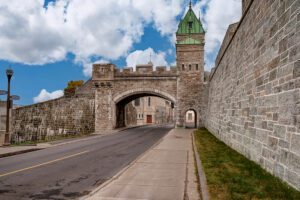
Kent Gate on Dauphine Street, in Quebec City, Canada. This gate is part of the historic fortifications of Quebec City
One of Old Québec’s most remarkable features is its system of fortifications. The city’s defensive walls, originally developed beginning in the 17th century and expanded over time, remain the only intact fortified city walls north of Mexico. Walking along the ramparts offers a rare opportunity to experience a landscape that has changed little in its overall character while revealing views of the river, the historic district, and the surrounding region.
Beyond the famous landmarks, Old Québec’s true magic is found in its details. The Upper Town’s elegant squares, stone façades, and historic churches reflect centuries of French influence, while the Lower Town’s winding streets preserve the atmosphere of a former port district where merchants, artisans, and travelers once gathered. Buildings constructed from local stone, hidden courtyards, and passageways connecting different levels of the city create an environment where exploration feels like stepping into another era.
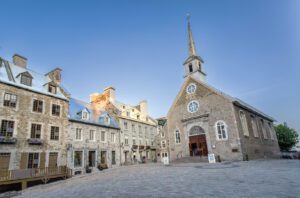
Notre-Dame-des-Victoires Church in Quebec
The district’s preservation is not simply about protecting old buildings. It is about maintaining a living community where residents, businesses, restaurants, and cultural institutions continue to shape the city’s future. Visitors can experience this blend of heritage and modern life through art galleries, museums, boutique shops, and restaurants that celebrate Québec’s unique traditions.
Among Old Québec’s most treasured historic landmarks is Notre-Dame-des-Victoires Church, located in the heart of Place Royale in the Lower Town. Built between 1687 and 1723, it stands on the site of Samuel de Champlain’s original settlement and is considered one of the oldest stone churches in North America. Its simple yet elegant architecture reflects the religious and cultural traditions of New France, while its location in one of the city’s oldest squares provides a direct connection to Québec’s earliest days as a French colonial settlement. The church’s survival through centuries of change illustrates the remarkable continuity that makes Old Québec such an important historic place.
 Perhaps the greatest reason Old Québec continues to inspire visitors is its unmistakable sense of place. Few cities allow people to walk through history so naturally, moving from centuries-old fortifications to lively cafés and scenic river overlooks within minutes. UNESCO’s recognition ensures that future generations can experience this rare connection between architecture, culture, and memory.
Old Québec is not preserved because it belongs only to the past. It is preserved because it represents a story that continues to unfold, offering the world a living example of how heritage can survive, adapt, and remain meaningful in the modern age.