
The truest indicator of modern luxury is no longer defined by what we build, but by what we choose to leave out. For decades, the design of the high-end estate has been dictated by an appetite for spectacular additions—shimmering infinity pools, flawlessly appointed outdoor kitchens, and pristine stone terraces engineered for grand entertaining. Yet, as our days grow increasingly fragmented by digital noise and the relentless demands of a hyper-connected world, a quiet counter-rebellion is taking root right outside our windows.
The most coveted amenity in the contemporary garden is no longer a structure at all. It is something infinitely rarer, entirely free, and remarkably difficult to capture: the absolute luxury of stillness.
This shift in perspective finds its deepest anchor in Shinrin-yoku, or forest bathing. The practice originated in Japan, where the term was introduced in 1982 by the Ministry of Agriculture, Forestry and Fisheries. Emerging during a period of rapid urbanization and technological change, it offered a simple antidote to the pressures of modern life: spending intentional, mindful time among trees. Over the subsequent decades, what began as a targeted cultural directive has developed into a rigorous subject of scientific study and, more recently, a global wellness phenomenon that scales from remote timberlands to private estates.
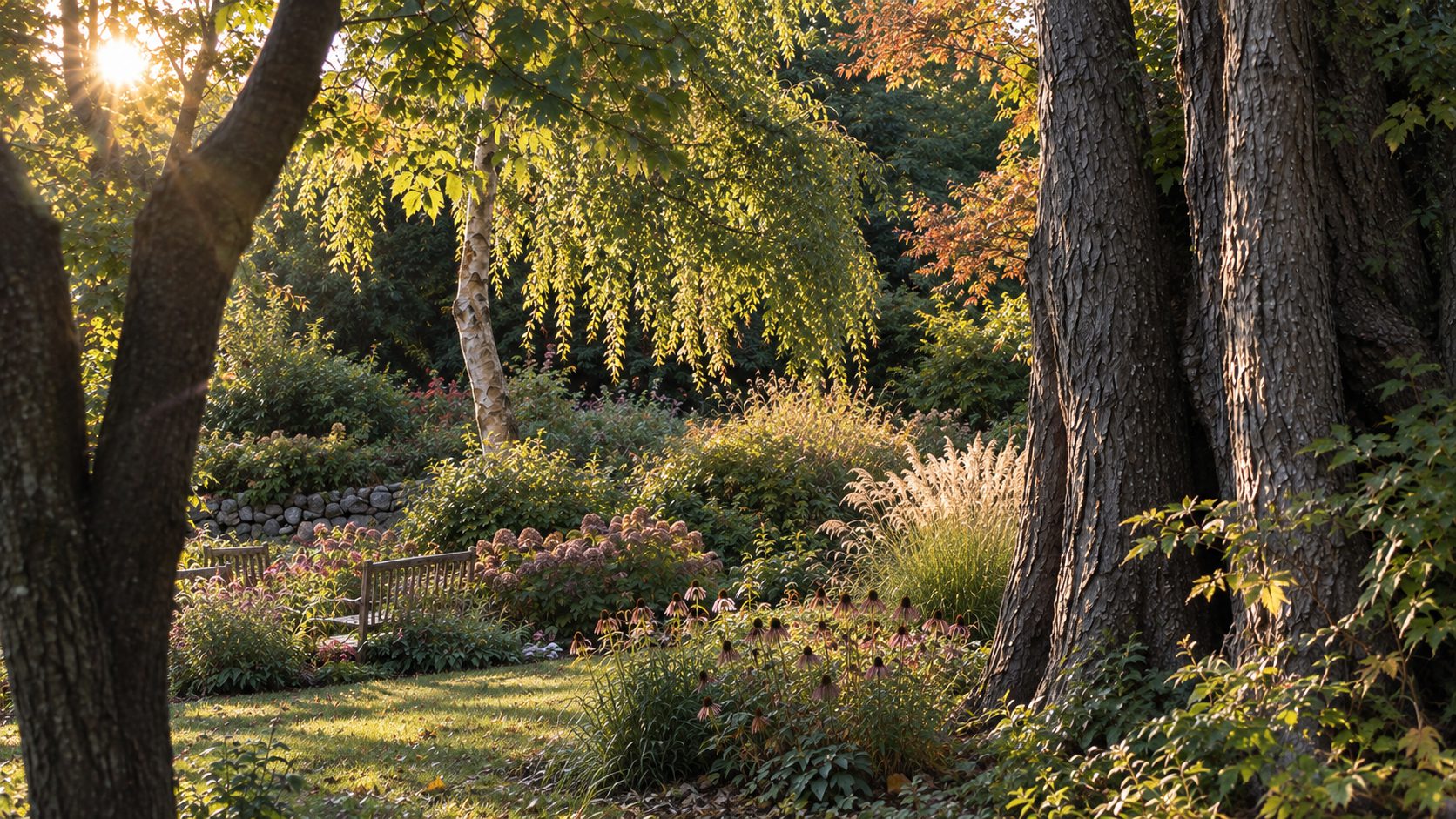
For the modern aesthetic, the garden offers a unique sanctuary that technology cannot replicate: a realm of sensory abundance that demands absolutely nothing of our fractured attention. This restorative environment does not require vast, sprawling acreage to work its magic. A mature courtyard shaded by a magnificent tree, a hidden pocket garden, or a terrace thoughtfully layered with greenery can transform into a deeply personal retreat. The only essential requirement is a willingness to slow down, listen, and truly perceive the landscape.
Crucially, science is now exploring what the spirit has always intuitively known. Research has associated time spent in forest environments with short-term changes in stress, heart rate, blood pressure, and mood. Studies have also investigated the potential influence of compounds released by trees, known as phytoncides. While researchers continue to investigate these complex effects—and this evidence should never be confused with proof that forest bathing treats physical disease—the broader relationship between time spent in nature and psychological well-being is increasingly compelling.
Forest bathing fundamentally alters how we inhabit our private landscapes. It coaxes us away from the typical internal dialogue of the homeowner—the constant evaluation of what needs pruning, watering, or replacing—and invites us to ask a far more elegant question: what is this living space offering to me?
Under this deliberate gaze, the architecture of the garden gracefully shifts. A winding flagstone path ceases to be a mere thoroughfare and becomes a meditative journey. A solitary bench beneath an ancient oak is reimagined as an intimate, open-air salon. A still pond becomes a mirror for personal reflection rather than a feature to be maintained.
True luxury has never been about excessive accumulation; it has always been about having access to what is genuinely rare. In an era of perpetual simulation, uninterrupted silence has become the ultimate status symbol. The future of exceptional landscape design is no longer just about creating a space to entertain or admire. It is about creating a space that restores, offering a timeless reminder that the greatest pleasure a garden can bestow is simply the exquisite permission to linger.

by Tammy Kovar, ELYSIAN Garden Subject Matter Expert, biologist, certified arborist, and enviropreneur, CEO of Biological Tree Services (BTS)