
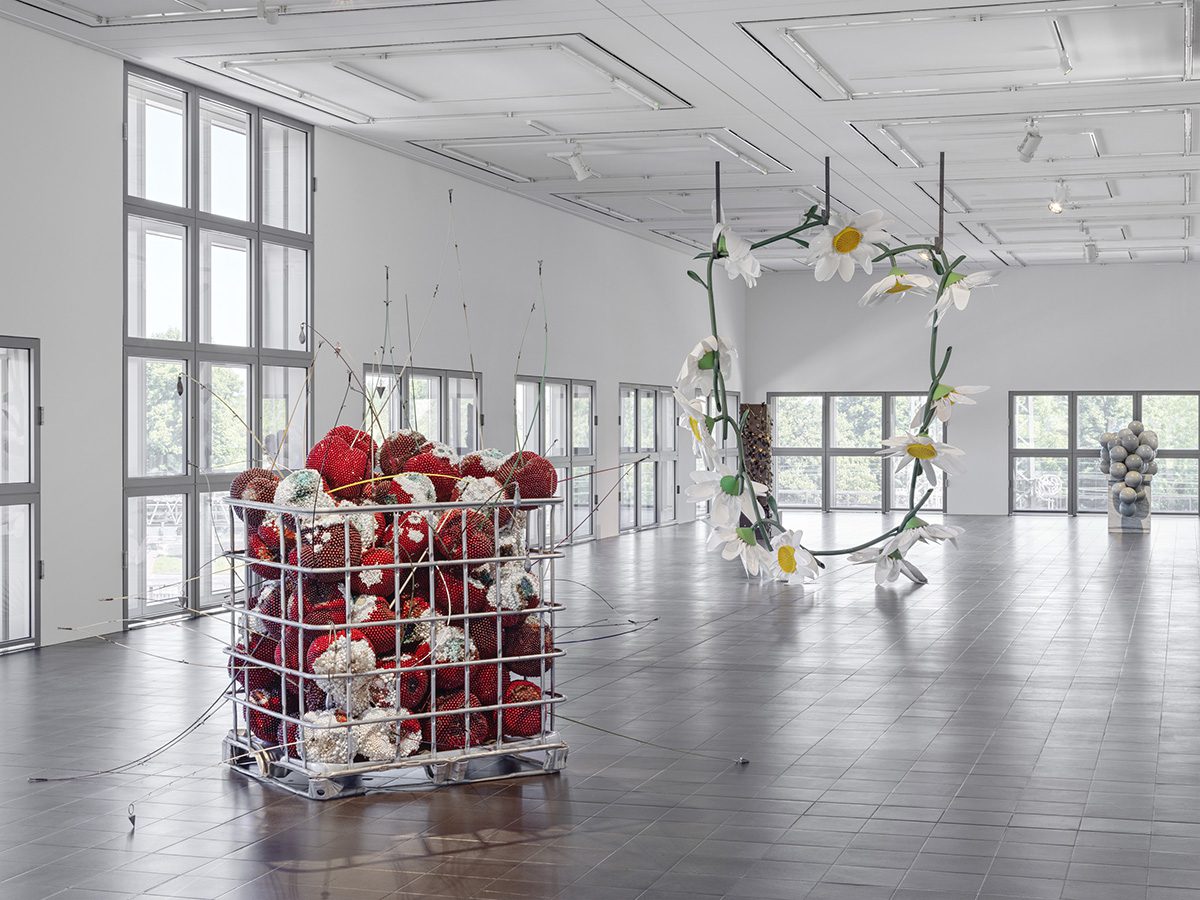
From May 17 to August 11 2024, the halls of the Hamburger Kunsthalle in Hamburg hosted a spectacle both sumptuous and unsettling: the first museum exhibition in Germany by American artist Kathleen Ryan. The exhibition marked a pivotal moment for the Santa Monica–born sculptor, whose work has captivated collectors and curators with its audacious exploration of beauty, consumption, and decay. Titled simply with the artist’s name, the show gathered roughly thirty sculptural works spanning a decade of practice—from 2014 to the present—tracing Ryan’s evolution into one of contemporary art’s most mesmerizing alchemists of material.
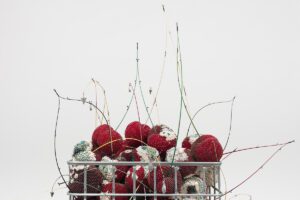
Kathleen Ryan (*1984) Bad Cherries, (Detail) 2021
At first glance, Ryan’s sculptures radiate opulence. Glittering gemstones, delicate beads, polished shells, and unexpected found objects shimmer under the gallery’s natural light. Yet a closer look reveals a provocative tension: these sumptuous materials form objects in states of rot. Mold blooms across fruit skins in dazzling mosaics of semi-precious stones. Oversized melons, peaches, and cherries appear both decadent and decomposing, transforming luxury into a meditation on impermanence.
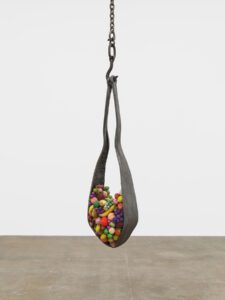
Kathleen Ryan (*1984) Hanging Fruit, 2018
Ryan’s celebrated work Bad Peach (Bite) exemplifies this seductive contradiction. What appears to be creeping mold across the peach’s surface is meticulously composed of hundreds of stones, each placed with jewel-like precision. Similarly, the massive rind of Bad Melon (Big Chunk)—constructed from parts of a dismantled Airstream motorhome—turns an icon of American mobility into the skin of decaying fruit. In Hanging Fruit, Ryan suspends clusters of jeweled fruit from the ceiling, their pendulous forms both alluring and ominous, as if caught in a slow, inevitable fall. Grapes in Bacchante are rendered in weighty concrete, while in Pearls, bowling balls are strung like exaggerated jewels. Through these startling material juxtapositions, Ryan reveals the strange poetry hidden in objects discarded or overlooked.
The exhibition space itself intensified the drama. Located in the airy Galerie der Gegenwart, the gallery’s wraparound windows flooded the sculptures with light, allowing their glittering surfaces to oscillate between seductive beauty and unsettling decay. Even visitors entering the museum encountered Ryan’s work unexpectedly: two sculptures hovered above the grand staircase of the historic main entrance, their contemporary irreverence sharply contrasting with the building’s stately Wilhelminian architecture.
Ryan’s practice has often been described as a contemporary echo of the vanitas tradition—a reminder that luxury, like life itself, is fleeting. But her work goes further. It is playful, even humorous, conjuring a world where bowling balls become pearls and tire fragments transform into fruit rinds. Within this imaginative whimsy lies a subtle promise: that materials, like ideas, can be reborn.
This theme of transformation reaches a dazzling peak in Dreamhouse, unveiled in Ryan’s 2025 exhibition Souvenir at Karma Gallery in Los Angeles. The monumental sculpture depicts a raspberry in the throes of decay. Its still-luscious flesh is composed of vibrant magenta plastic beads, while its spreading mold blooms in deep blues and greens—formed from gemstones such as lapis lazuli, malachite, and turquoise. Hollow at its core, the berry becomes a glittering cavern lined with crystalline stalactites and stalagmites, inviting viewers to peer into its sparkling interior.
The piece took three years to create and marks the first raspberry in Ryan’s acclaimed “Bad Fruit” series, which began in 2018. Across the series, Ryan enlarges ordinary fruit to fantastical proportions, encrusting their surfaces with thousands of beads and semi-precious stones. A single lemon, she once revealed, may contain over 10,000 individual pieces. The works shimmer with excess—but embedded within their brilliance is the unmistakable suggestion of decline.
Ryan herself has acknowledged this tension. Her sculptures reflect a world where opulence expands even as environmental and social costs accumulate. Yet paradoxically, the mold—the very symbol of decay—becomes the most vibrant and alive element of the work.
In 2024, Ryan’s meteoric rise reached another milestone when Gagosian announced global representation of the artist, signaling a new chapter in her career. Her debut exhibition with the powerhouse gallery is scheduled for 2026, with details still to come. If her past work is any indication, the next stage promises to be as dazzling as it is disquieting—an invitation to witness firsthand the strange, glittering beauty of decadence in decay.