
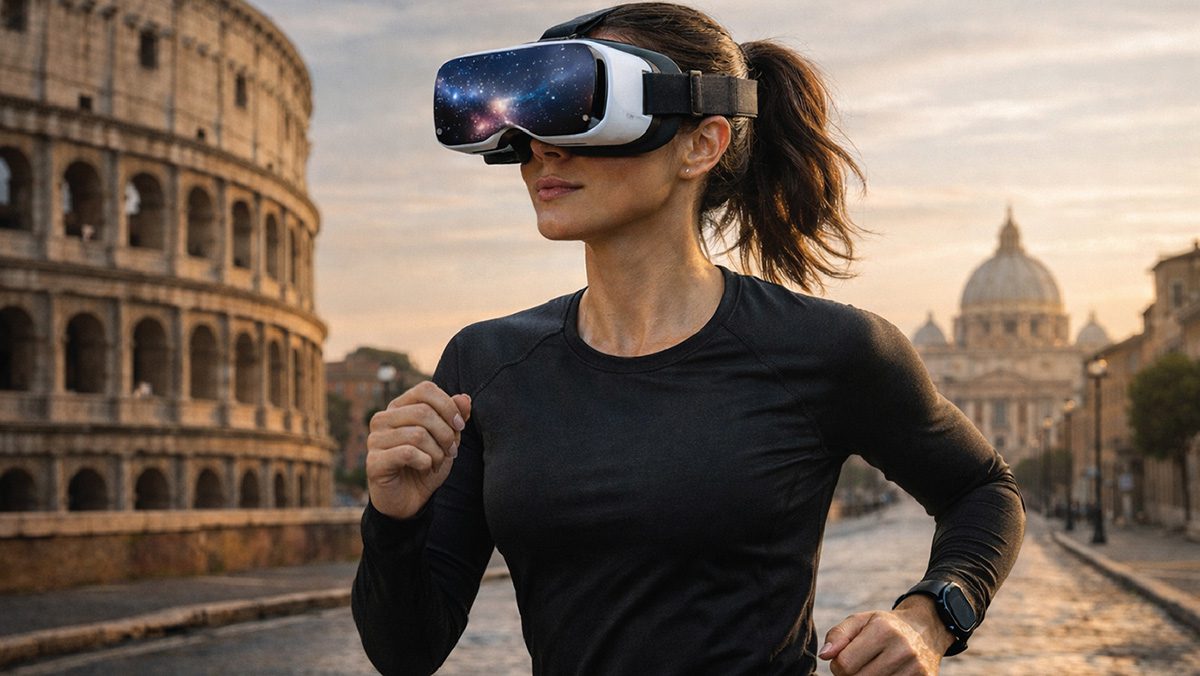
The steady rhythm of a run has always been meditative—but a new generation of training experiences is transforming cardio into something far more transportive. AI-generated fitness realms are redefining what it means to work out, replacing static screens and repetitive routes with fully immersive worlds that respond to the body in real time. One moment, the path winds through sunlit stone corridors of Ancient Rome; the next, it ascends into a floating city suspended among clouds. Movement becomes narrative. Effort becomes exploration.
At the center of this evolution is artificial intelligence capable of building dynamic environments that adapt instantly to pace, cadence, heart rate, and fatigue levels. Speed up, and the terrain shifts accordingly—cobblestones smooth into marble roads, or a mountain ascent steepens to match exertion. Slow down, and the world subtly recalibrates, encouraging recovery without breaking immersion. Unlike traditional virtual workouts, these realms are not pre-recorded simulations. They are living systems, shaped continuously by biometric feedback.
This technology is proving especially compelling for endurance training. Preparing for a half or full marathon has long required imagination—visualizing the course from maps or grainy videos. AI fitness realms change that entirely. Runners will soon be able to train on an exact digital twin of a race route months before traveling, experiencing elevation changes, turns, surface textures, and even landmark pacing cues. The streets of Rome, the hills of San Francisco, or the long bridges of Berlin can be run repeatedly, allowing the body and mind to internalize the course before race day arrives.
The psychological advantage is significant. Familiarity reduces anxiety, sharpens pacing strategy, and builds confidence. Muscles learn when climbs appear. Breathing patterns adapt to known stretches. By the time the actual event begins, the route feels remembered rather than unknown.
Powering this realism are omnidirectional treadmills—advanced platforms that allow movement in any direction while keeping the runner centered. Using low-friction surfaces, specialized footwear, and responsive sensors, these treadmills detect force and direction, instantly counteracting forward motion so the body remains stationary in physical space while moving freely in the virtual world. Turning corners, adjusting stride, or accelerating uphill all register naturally, without buttons or manual controls. The result is a sensation far closer to outdoor running than conventional treadmills can provide.
Paired with premium hardware—lightweight headsets, motion-tracking systems, and precision biometric monitors—these environments deliver a level of feedback once reserved for elite training facilities. Heart rate variability, stride efficiency, oxygen utilization, and recovery metrics are analyzed continuously, allowing workouts to be refined session by session. Bespoke soundscapes further deepen immersion, syncing breath, footfall, and ambient audio to create flow states that make time dissolve.
What emerges is a new relationship with fitness—one that stimulates curiosity as much as discipline, imagination as much as endurance. Cardio becomes experiential rather than obligatory, strategic rather than monotonous. Training is no longer about escaping the mind to push the body, but engaging both in harmony.
As AI fitness realms continue to evolve, they signal a future where preparation is precise, environments are limitless, and performance is shaped as much by mental engagement as physical effort. The road to the finish line has never been more expansive—or more compelling.