
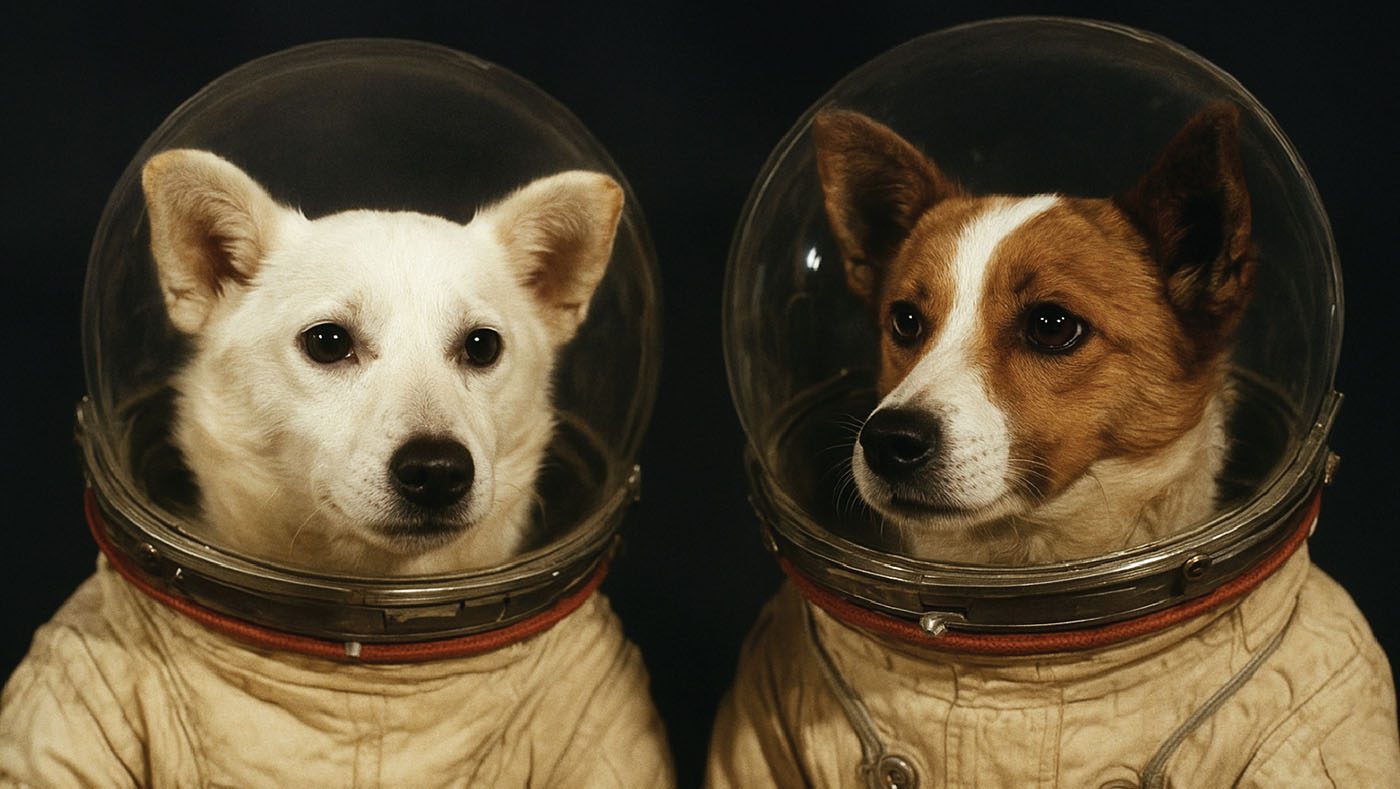
From orbiting Earth to diving beneath the ocean’s surface, dogs have proven themselves to be some of history’s most fearless explorers. Their courage has carried them to places even the bravest humans might hesitate to go—from the cold vacuum of space to the icy reaches of the South Pole and the mysterious depths of the sea. These stories remind us that loyalty and bravery come in many forms, sometimes covered in fur and carried on four determined paws.
Long before a human ever left Earth’s atmosphere, the Soviet Union turned to dogs to answer one of science’s most daring questions: Could a living being survive in space? Between the 1950s and 1960s, the Soviets launched dozens of dogs aboard rockets, testing the boundaries of life beyond gravity. Their choices were deliberate—they didn’t select purebreds. Scientists believed mixed-breed strays were hardier, more intelligent, and better able to endure the physical and psychological stress of flight. They also chose mostly females because they were smaller, lighter, and more docile, making them better suited to the cramped spacecraft.
Among these pioneering canines, Belka and Strelka stand out as true space legends. In August 1960, the two small dogs were launched aboard Sputnik 5 alongside a rabbit, forty mice, and two rats. They orbited Earth for more than 24 hours, enduring weightlessness, noise, and isolation before returning safely—wagging their tails upon landing. Their survival proved that living organisms could endure orbital flight, clearing the path for human space exploration. Strelka later gave birth to six puppies, one of whom was gifted by Soviet Premier Nikita Khrushchev to U.S. First Lady Jacqueline Kennedy—a gesture of peace in the midst of the Cold War.
A few years later, Veterok and Ugolyok would set another record, spending an astonishing 22 days in orbit in 1966 aboard Cosmos 110, a feat not surpassed by humans until the Soyuz missions five years later. These dogs endured heat, confinement, and weightlessness for more than three weeks before returning safely to Earth—true spacefarers in every sense.
While space dogs captured headlines, their Earth-bound counterparts were making history in other ways. Canine explorers have joined mountaineers, mushers, and divers on some of the planet’s most extreme adventures. The U.S. Navy SEALs train dogs to parachute from planes and even scuba dive in the dark depths of the ocean, their calm focus and acute senses making them invaluable partners in high-risk missions. These elite animals wear oxygen masks and waterproof vests, leaping into black water where courage is measured in heartbeats.
Not all heroism requires rockets or diving gear. Sometimes, bravery is measured in love. In 2008, at a zoo in Caney, Kansas, a golden retriever named Isabella became a surrogate mother to three tiger cubs abandoned by their birth mother. Without hesitation, Isabella nurtured the cubs as her own—nursing, cleaning, and protecting them with maternal devotion. Zookeepers watched in awe as she bridged the wild divide between species, giving the cubs the start in life they’d been denied. When the tigers grew too large for unsupervised play, Isabella watched them move on, her job complete, her heart full.
From the cold expanse of space to the tender warmth of a mother’s care, dogs have shown humanity what courage, adaptability, and love truly mean. They remind us that adventure isn’t just about where you go—it’s about the spirit you carry there. Whether circling the stars or cradling orphaned cubs, these extraordinary dogs prove that sometimes, the bravest explorers walk on four legs.