
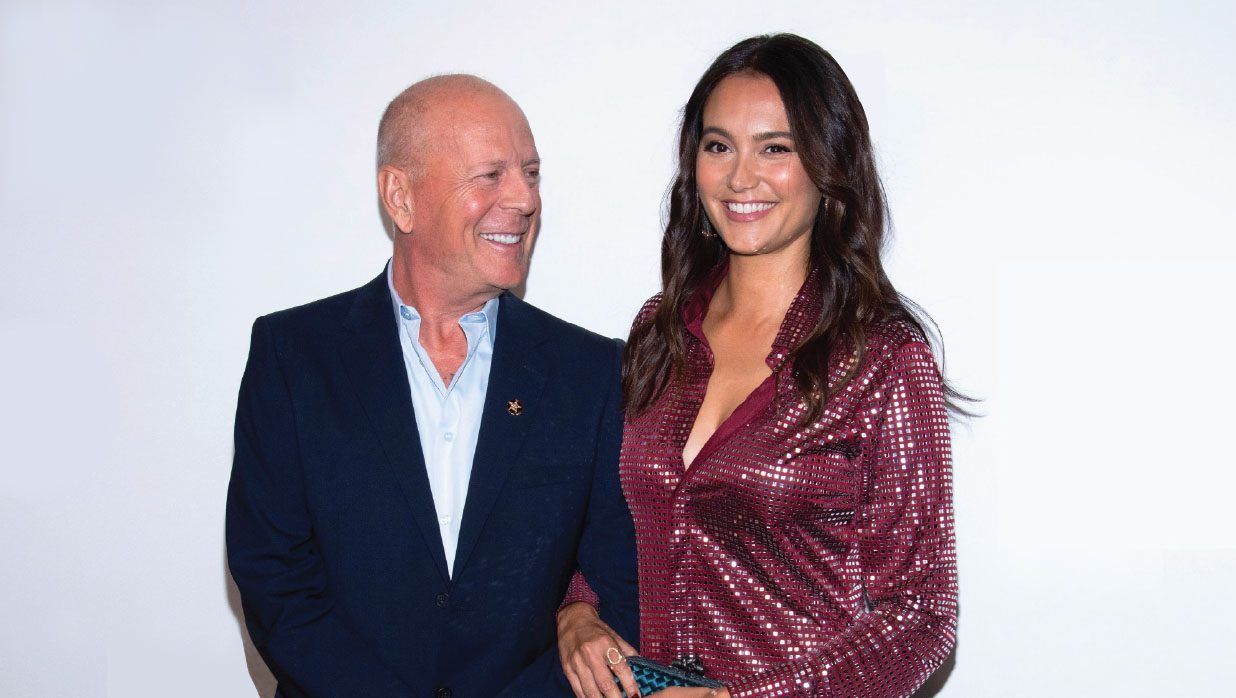
When Bruce Willis’s dementia diagnosis became public, his wife Emma Heming Willis quietly but powerfully pushed back against the narrative of tragedy—showing that joy and love can endure even through illness. This feature explores how the Willis family is redefining dignity, connection, and advocacy—offering a poignant lesson in controlling one’s own story and finding grace in the face of loss.
Emma and Bruce first met in 2007 at their mutual trainer’s gym, and the pair made their first public appearance together in early 2008. They married on March 21, 2009, at a ceremony in Turks & Caicos, followed six days later by a civil ceremony in Beverly Hills. At roughly the time Bruce publicly stepped away from acting in 2022—after a diagnosis of aphasia—the couple had been married for about 13 years.
Rather than allowing his diagnosis to define their story as one of inevitable decline, Emma reframed it through the lens of enduring love and shared purpose. The family’s announcement in March 2022 noted Bruce’s diagnosis of aphasia. Later, in February 2023, the diagnosis was refined to Frontotemporal Dementia (FTD). Through Instagram posts, interviews, and her own emerging advocacy, Emma spotlights what remains whole—the family’s connection, their laughter, everyday rituals, and Bruce’s unmistakable presence.
This perspective is more than personal—it is transformative. By choosing to focus on what still gleams within their life, she subverts the conventional narrative around chronic illness, which often emphasizes suffering and loss above all else. Instead, Emma highlights that dignity, agency, and joy are still very much part of their lived reality. In one social‑media post on Father’s Day 2025 she wrote: “What Bruce teaches our girls goes far beyond words… Love deepens. It adapts. It stays, even when everything else changes.”
Emma’s advocacy extends beyond private expression. She has become a voice in the caregiving and neuro‑health communities, raising awareness about aphasia, FTD, and the broader impact on families. Her website states: “My goal is to see an end to FTD and all forms of neurodegenerative disease, while providing community and support for care partners.” Her public stance reframes the role of a partner or caregiver from one of quiet sacrifice to one of visible strength and leadership.
Equally remarkable is how the couple continues to cultivate joy within their family of five daughters—two shared with Emma and Bruce, and three older daughters from Bruce’s previous marriage. Whether celebrating everyday milestones or sharing candid glimpses of family life, Emma reinforces that happiness is not a denial of illness but a conscious affirmation of life. In this, the family offers a universal lesson: even when circumstances change, love and connection endure.
A major milestone in this journey came with Emma’s upcoming memoir and caregiving guide: The Unexpected Journey: Finding Strength, Hope and Yourself on the Caregiving Path, released September 9, 2025. The book, authored by Emma Heming Willis, draws on her personal experience as a care partner to Bruce and shares insights from top dementia, caregiving and integrative health experts. It was conceived out of the blank‑stare moment she left the doctor’s office in, with “a pamphlet and a hollow goodbye” in hand. The book sets out to be the guide she wished existed when they first received the diagnosis and extends her message of hope, resilience and community to other families facing neurodegenerative illness.
Ultimately, Emma Heming Willis is rewriting what it means to navigate illness in the public eye. She refuses to allow the narrative to be one‑dimensional; she refuses pity, and instead frames the journey as one defined by love, resilience, and dignity. By doing so, she doesn’t just uplift her own family—she offers a broader blueprint for any family confronting uncertainty: you may not choose the diagnosis, but you can choose the story you live. In showing that a diagnosis does not erase identity, that joy can coexist with challenge, and that love can thrive even when the path changes, Emma and Bruce—and the family they’ve built—offer hope, courage, and a profound reminder that the stories we tell about ourselves can be as meaningful as the lives we lead.