
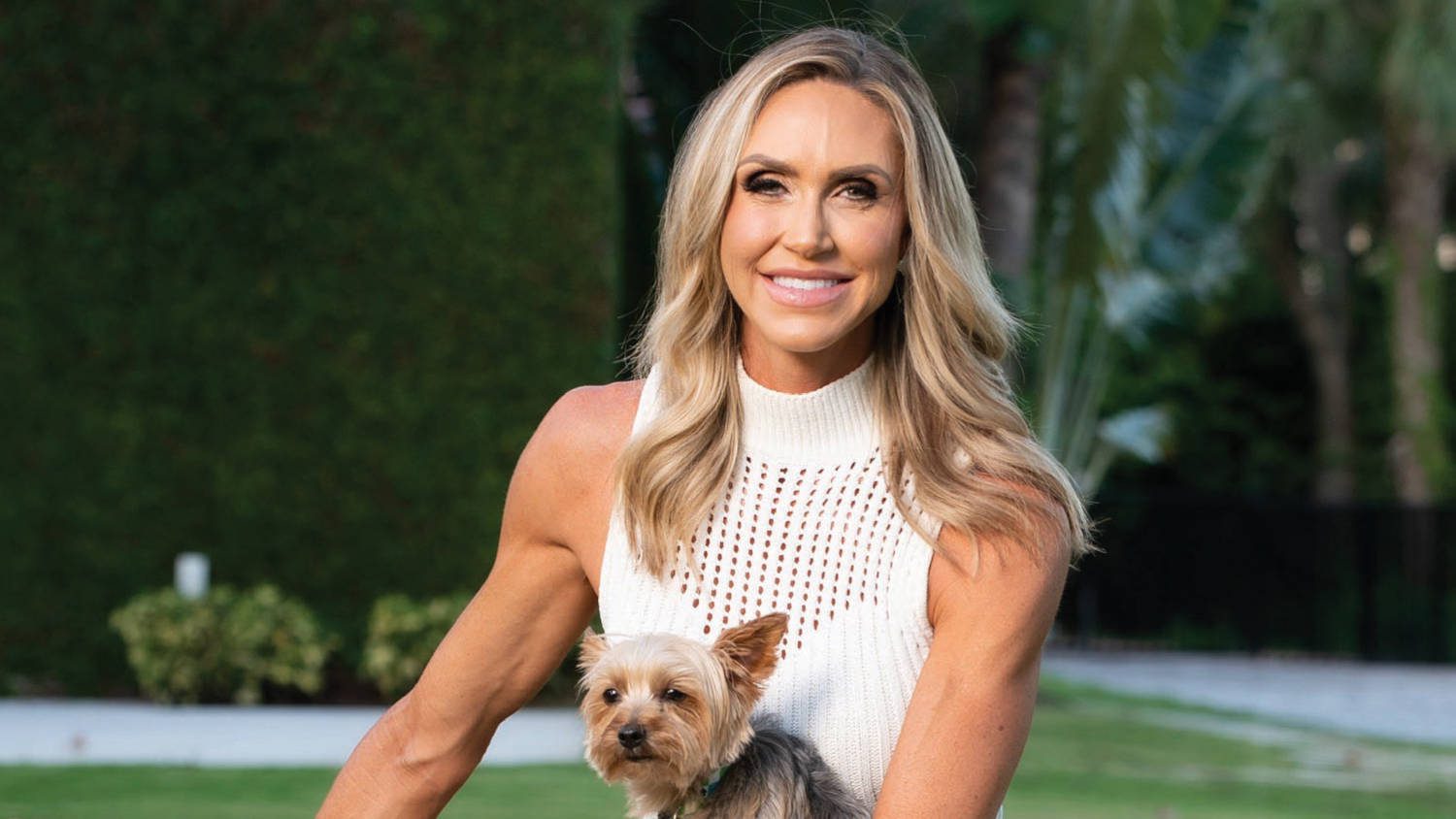
In every political era, there are figures who move with a different kind of presence—shaping not only the conversation, but the way it is felt and understood. LARA TRUMP has emerged as one of those figures, navigating a space where politics, communication, and personal narrative quietly intersect.
Her path has unfolded during a period of rapid transformation, both within the Republican Party and across the broader media landscape. In that environment, her role has been defined less by any single title than by her ability to connect—carrying ideas across platforms, audiences, and moments with a sense of clarity and continuity. Moving between campaign strategy, party leadership, and broadcast media, she has developed an instinct for how messages resonate, and how alignment is maintained in a landscape that is constantly shifting.
At its core, her story reflects a more expansive understanding of influence—one shaped not only by position, but by voice, presence, and the ability to create connection in an increasingly complex public life.
Lara Trump has become one of the most recognizable women in contemporary Republican politics, but her public life has never belonged to a single lane. Over the last decade, she has moved fluidly among campaign strategy, political messaging, broadcast media, and public advocacy, building a profile that blends family legacy with her own on-camera ease and political instincts. In today’s conservative landscape, where message discipline and cultural fluency often matter as much as formal titles, she has emerged as a figure uniquely positioned at the intersection of politics, media, and movement energy.
Her current role reflects that convergence. Lara Trump joined Fox News in 2025 as host of My View with Lara Trump, a weekend program that placed her directly inside one of the most influential media ecosystems in American conservative life. Fox describes her not simply as a political figure, but as a television personality, entrepreneur, and advocate for conservative values, an encapsulation that hints at the breadth of the persona she has cultivated. The move was less a reinvention than an evolution. By the time she arrived in weekend primetime, she had already spent years learning how to speak to the Republican base in a language that feels less like institutional politics and more like direct, personal conversation.
That sensibility has roots in both media and place. A native of North Carolina, Lara Trump grew up in Wilmington and graduated from North Carolina State University before heading to New York to continue her studies at the French Culinary Institute. Long before she became a visible political surrogate, she worked in television production, including a stint as a producer and story coordinator for Inside Edition, a role that helped sharpen the skills that would later define her public presence: pacing, message construction, visual awareness, and an understanding of what lands with audiences in real time.
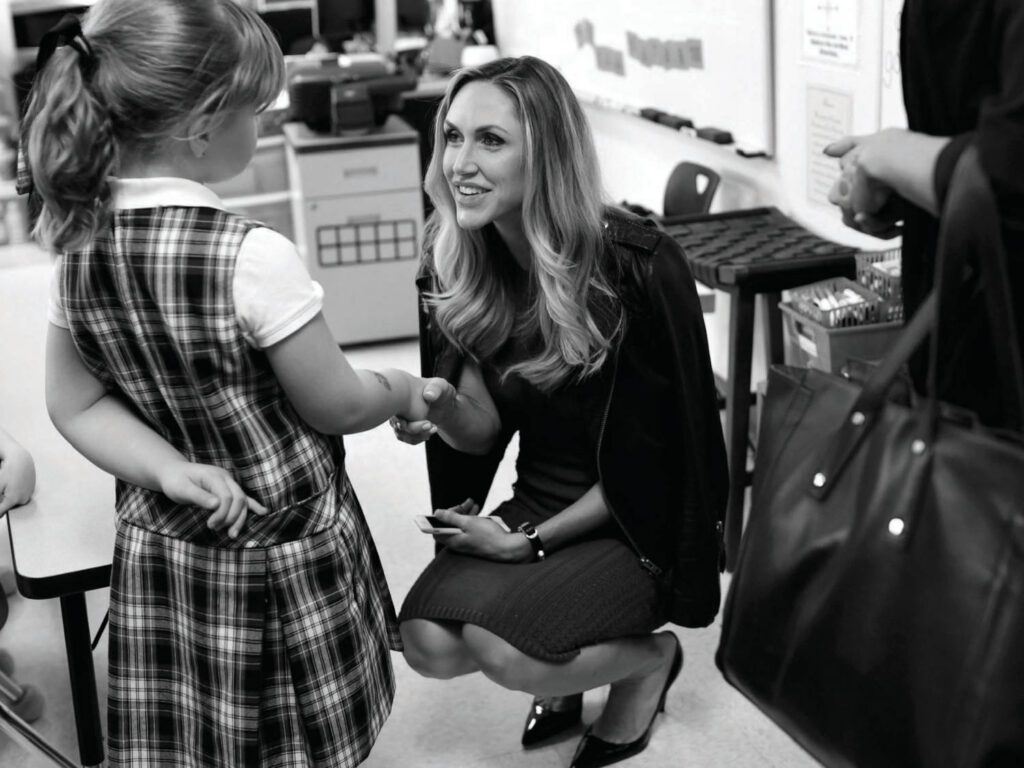
Beyond the political stage, Lara Trump’s public life has long reflected a devotion to family, wellness, and the quiet causes that shape character. On the trail, she cultivated a direct rapport with supporters, embodying the energy and intimacy that often animate grassroots movements.
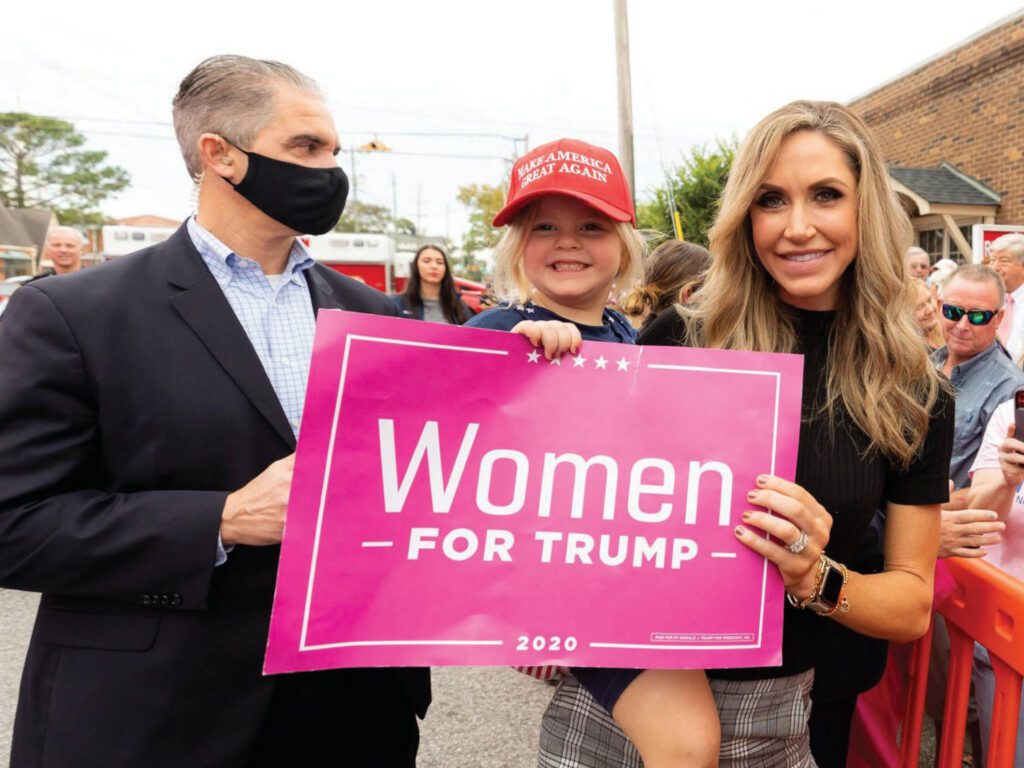
That background matters because Lara Trump’s rise has always been about more than surname alone. Marriage placed her inside one of the most scrutinized families in American public life, but it was media fluency that made her useful to the political project around her. During Donald Trump’s 2016 presidential campaign, she became an active surrogate and a familiar presence on the trail, particularly in North Carolina, where her local ties gave her a distinctive role. Fox notes that she played an important part in campaign efforts there, while broader reporting has consistently described her as one of the family members most comfortable translating Trump- world priorities into voter-facing language. By 2020, that role had expanded: she served as a senior adviser to the Trump campaign, taking on a more formal place within its strategic and communications apparatus.
In many ways, that period clarified her political identity. Lara Trump was not presented merely as a family emissary, but as one of the campaign’s most visible validators, someone able to move between rallies, interviews, digital content, and surrogate operations with relative ease. The public-facing quality that might once have belonged only to campaign wives or daughters had evolved into something more contemporary: she became a hybrid figure, at once insider and communicator, positioned to reinforce both message and mood. That model only intensified after 2020, when she launched The Right View, a conservative web series and podcast that allowed her to address audiences outside the rhythms of traditional television. Fox describes the show as one that quickly built a substantial following, widening her direct connection with viewers and reinforcing her presence as a recognizable conservative media voice in her own right.

Her most formal political power came in 2024, when she was elected co-chair of the Republican National Committee. The appointment, backed by Donald Trump and his allies, was widely understood as part of a broader effort to align the party’s governing structure more closely with his political movement. Associated Press reporting at the time described her ascension as a key moment in the reshaping of the RNC, and Lara Trump herself made clear that her mission was unapologetically tied to electing Donald Trump in 2024. She served as co-chair from March 2024 until January 2025, helping oversee a crucial cycle in which party infrastructure, fundraising, and turnout were all under intense scrutiny. Whatever one’s politics, the significance of that role is clear: she moved from campaign surrogate to formal party leadership, a shift that underscored how central she had become within the Republican coalition aligned with Trump.
Yet one of the more interesting dimensions of Lara Trump’s public image is that it has never been constructed solely through politics. Fox’s profile emphasizes her interest in wellness, fitness, and animal rescue, noting her participation in triathlons and CrossFit and her advocacy for shelter animals. These details are not incidental. They are part of a broader pattern in contemporary public life, especially for women in politics-adjacent roles, where influence often depends on a mix of ideological clarity and lifestyle relatability. Lara Trump’s public-facing brand has long leaned into that blend: disciplined but accessible, political but not exclusively so, aligned with movement conservatism while still framed through the language of family, health, and everyday values.
She has also become a figure through whom several larger American shifts can be read at once. Her career charts the collapse of clear boundaries between campaign work and media work, between family visibility and party power, between political advocacy and personal branding. In an earlier era, those categories might have remained more separate. In the current one, they are often mutually reinforcing. Lara Trump is a particularly vivid example of this new political-media synthesis: a former producer who became a campaign surrogate, a party official, a digital host, and now a cable-news anchor, all while remaining closely associated with one of the most dominant political brands in modern American history.
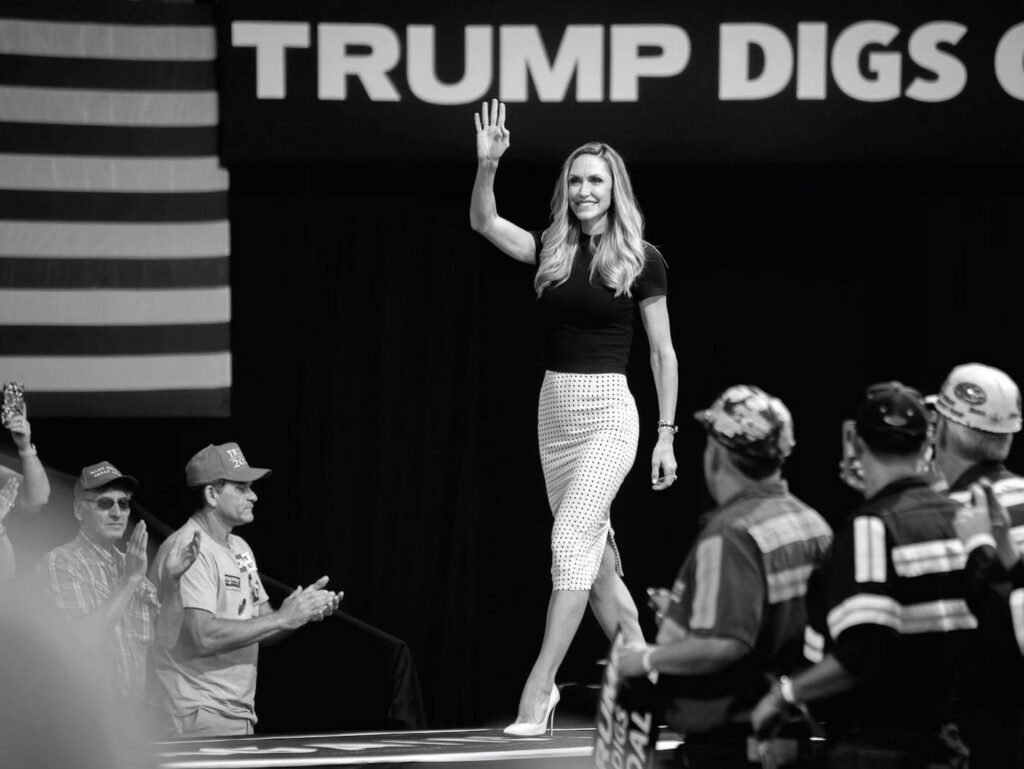
At the podium, Lara Trump steps into one of her defining roles: communicator, advocate, and commanding presence in the national conversation. In candid moments of connection, another dimension emerges—leadership expressed not only through conviction, but through approachability and care. Set against the sweep of a crowd, she moves where message, momentum, and the choreography of modern political life converge.
That does not make her easy to categorize, which may be part of her staying power. To supporters, she represents loyalty, composure under scrutiny, and a capacity to speak with both polish and conviction about the values animating today’s Republican base. To critics, she symbolizes the deep entanglement of media power, political dynasty, and party machinery in the Trump era. But even that tension says something useful. Lara Trump’s public role is not incidental to the current political moment. It is expressive of it. She stands at a cultural crossroads where politics, family, and communication converge—each playing a role in how public life is shaped and experienced.
What remains most striking is how deliberately she has inhabited that space. From North Carolina roots to New York media, from campaign trail surrogate to national party co-chair, from digital host to Fox anchor, Lara Trump has built a career around visibility and message. And in a political age defined by both spectacle and fragmentation, she has understood something essential: that influence belongs not only to those who hold office, but also to those who shape how politics is seen, heard, and felt.