
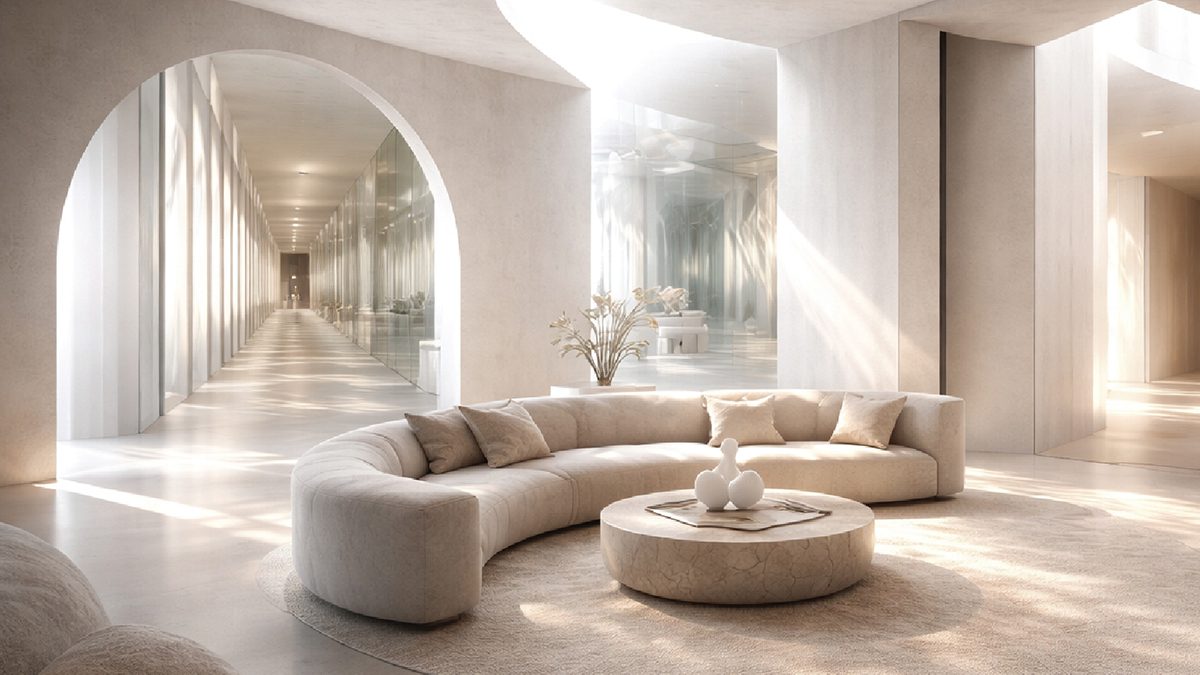
What if your home could deceive you—in the most beautiful way? Imagine stepping into a room that seems to stretch endlessly, walls that dissolve as you move, and spaces that shift with your perspective. This isn’t science fiction—it’s the emerging world of psychological architecture, where spatial illusion design transforms homes into environments you don’t just inhabit, but question. This is architecture that bends reality.
For centuries, humans have been drawn to spaces that defy logic—mazes, mirrored rooms, and impossible structures that challenge perception. In residential design, however, intentionally manipulating space is a newer frontier. One early and iconic example is the Winchester Mystery House in San Jose, California. Built between 1886 and 1922 by Sarah Winchester, the 160-room Victorian mansion is filled with strange architectural choices: staircases that lead to ceilings, doors that open into nothing, and hallways that go nowhere. Legend claims Winchester designed it this way to confuse spirits, but regardless of belief, the house stands as a compelling precursor to today’s psychological architecture.
Spatial illusion design works by subtly deceiving the senses through geometry, materials, light, and perspective. It doesn’t rely on gimmicks but on thoughtful design that reshapes how we experience space. Hallways suggest hidden dimensions. Stairs unfold in unexpected ways. Doors invite reinterpretation. In this approach, a home is no longer static—it becomes perceptual and dynamic.
While fully immersive illusion-based homes are still evolving, several architects are already pushing boundaries. Designer Duyi Han creates environments that feel fluid and responsive, using curtains, layered materials, and maze-like layouts to evoke instability. Khan Bonshek Architects challenges traditional domestic forms with projects like the reimagined Pyramid House, where geometry disrupts conventional living patterns. Höweler + Yoon merges art, light, and perception to create spaces that feel interactive and cinematic. Together, these innovators show that spatial illusion is not a novelty—it’s an emerging design language.
This movement is driven by several forces. Human curiosity fuels a desire for spaces that surprise and delight. Advanced digital tools now allow architects to design complex forms once impossible to calculate. Influences from immersive art, virtual reality, and film have also reshaped expectations. From the dreamlike spatial illusions of M.C. Escher to the immersive installations of James Turrell, we’ve grown accustomed to spaces that feel larger, stranger, and more dynamic than reality. Architecture is beginning to reflect that shift.
So why design a home that deceives the senses? In a world of increasingly uniform, utilitarian housing, these spaces offer something more—emotional richness. They transform everyday living into an experience of discovery and wonder. Movement through the home becomes engaging rather than routine. Design becomes a form of storytelling, reflecting personality, creativity, and philosophy.
Today, architecture is no longer just about shelter—it’s about experience. Walls become opportunities rather than limits. Light and shadow act as collaborators. Geometry becomes narrative. In psychological architecture, reality itself is a design choice. The home becomes not just a place to live, but a place to feel fully alive.
Would you step into a home that challenges your perception at every turn?