
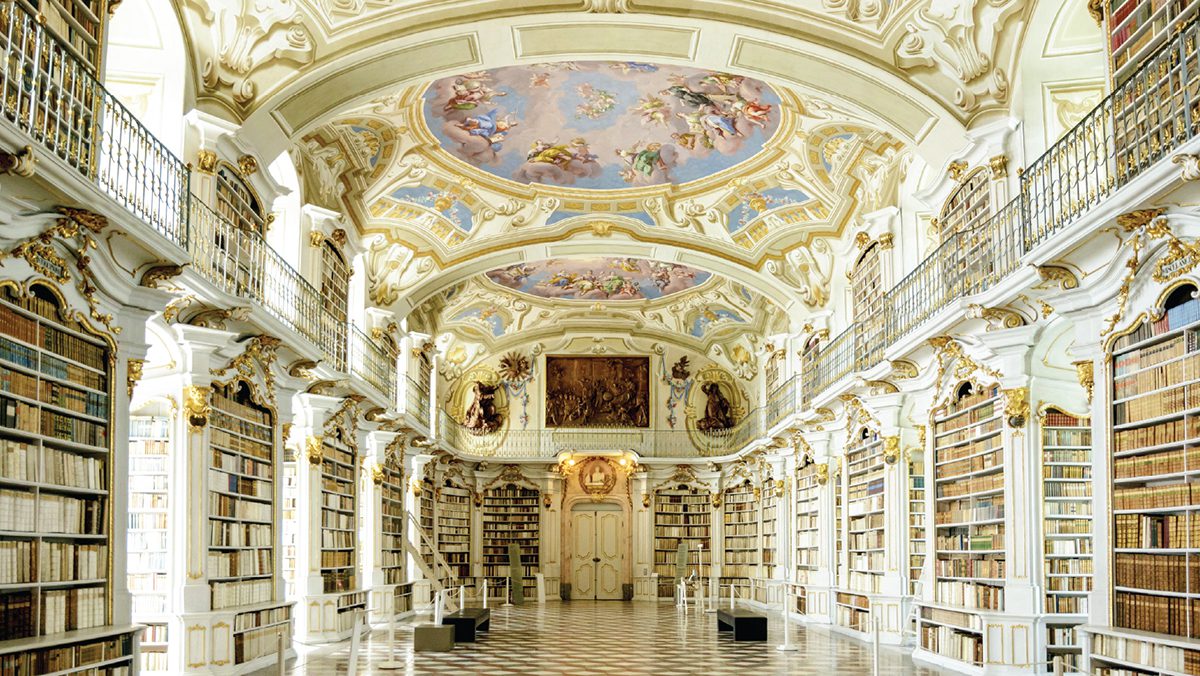
 In the Austrian Alps, there exists a library that feels less like a place of study and more like a secret chapter pulled from a fairytale. The Admont Abbey Library—completed in 1776 at the height of the Baroque era—unfolds in a breathtaking sweep of white, gold, and light, where seven frescoed cupolas seem to float above 70,000 volumes like a painted sky of knowledge.
Located within the Benedictine monastery of Admont Abbey, the library is widely regarded as the world’s largest monastic library. It was designed by architect Josef Hueber, with ceiling frescoes by Bartolomeo Altomonte, and it remains one of the most striking architectural expressions of Enlightenment thinking in Europe.
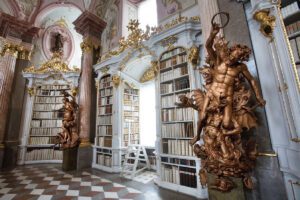
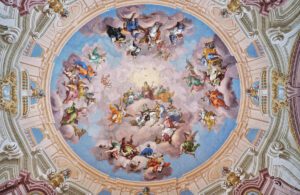 The library hall itself is a masterwork of illusion and intention. Its soaring ceiling is divided into seven domes, each painted with allegorical frescoes representing stages of human knowledge—religion, science, art, and philosophy—surrounded by gilded stucco and intricate ornamentation. The walls are lined with walnut shelving carved into graceful curves, softened by white plaster and gold detailing that reflect light in a way that makes the entire space feel luminous, almost weightless.
When it was completed in 1776, the experience of entering the library would have been radically different from today. At that time, it was reserved primarily for the monks of the abbey, who used it as both a working scholarly space and a spiritual extension of their monastic life. Illumination came from tall windows during the day and candlelight in the evenings, casting flickering shadows across manuscripts and early printed books. The silence would have been deeper, broken only by the turning of pages and the soft movement of robes across stone floors.
Today, the Admont Abbey Library is open to the public as part of the monastery’s museum, allowing visitors to step into a space once reserved for contemplation and study. Modern lighting, climate control, and preservation systems now protect the collection, but the emotional impact of the room remains intact. Visitors still find themselves instinctively lowering their voices, as though the architecture itself enforces reverence.
 Among its approximately 70,000 volumes in the main hall are works spanning theology, philosophy, law, natural sciences, and early European literature. The collection reflects the intellectual curiosity of a monastic order deeply engaged with the world beyond its walls, even while living in seclusion.
One of the library’s most intriguing features is its set of hidden doors, seamlessly integrated into the shelving. These are not secret passages in the cinematic sense, but functional, nearly invisible entryways that allow monks and caretakers to move between the library, upper galleries, conservation rooms, and other parts of the monastery. Their design reinforces the building’s central idea: that knowledge, like architecture, should be continuous and interconnected rather than compartmentalized.
Constructed using materials such as carved walnut wood, stucco marble, gilded accents, and hand-painted plaster, the library was built not only to house books, but to embody the Enlightenment belief that beauty and reason could exist in perfect harmony. Even today, it feels less like a static historical monument and more like a living expression of that idea—one where knowledge is not simply stored, but elevated into something almost sacred.