
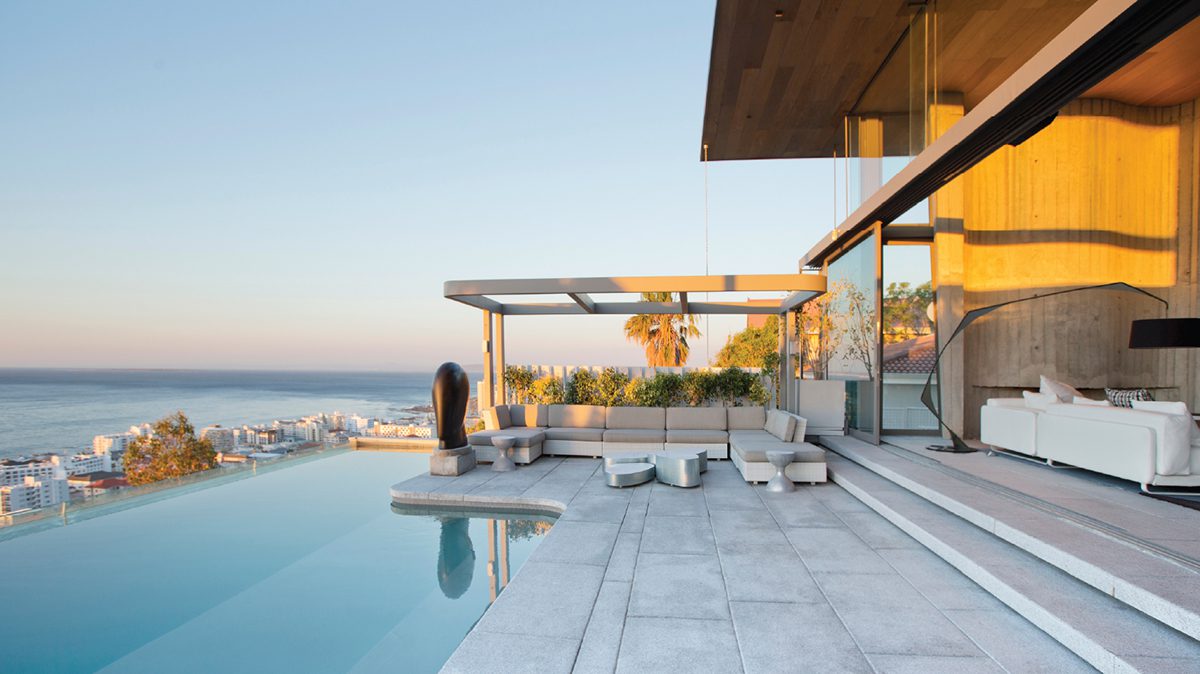
The future of outdoor living is no longer defined by furniture, landscaping, or even architecture alone. It is defined by intelligence. This season, the most compelling shift in high-end design is the rise of climate-adaptive outdoor environments, also known as smart, responsive landscapes. These are spaces that do not simply exist but respond, anticipate, and transform.
At its core, this innovation reimagines the outdoors as something fluid. Outdoor living spaces are now being designed to automatically respond to weather, light, and temperature in real time, dissolving the traditional boundary between interior and exterior. The result is an environment that feels both natural and completely controlled, effortless, seamless, and deeply luxurious.
What does this look like in practice? Imagine a terrace where a retractable glass roof senses incoming rain and quietly closes before a single drop falls. Pergolas rotate or louver throughout the day, adjusting to the sun’s exact position to maintain perfect light and shade. As temperatures drop, heated flooring and seating activate beneath you, creating warmth without interruption. Invisible wind-sensing screens rise when needed, then disappear just as quickly. Entire outdoor rooms can enclose themselves in seconds or open fully to the sky depending on mood or climate.
These are not gadgets layered onto a space. They are fully integrated architectural systems designed from the ground up to behave as part of the environment itself. Leading companies like StruXure and Renson are at the forefront of this movement, engineering pergolas and outdoor structures that autonomously respond to weather conditions while maintaining a sleek, minimal aesthetic. Their systems exemplify a new kind of luxury where technology is present but never visible.
This is precisely why the trend is gaining traction among ultra-high-end clients. Today’s luxury homeowner is no longer interested in checking the forecast or adjusting their environment manually. They want spaces that adapt to them automatically, homes that remove friction, anticipate needs, and operate with quiet precision. Outdoor areas are becoming year-round living environments that function in any season, controlled sensory experiences where light, temperature, and atmosphere are curated in real time, and seamless extensions of interior design with no clear boundary between inside and out.
At a deeper level, this movement reflects a broader shift toward what designers are calling responsive living. Homes are no longer static structures but dynamic systems that anticipate behavior, adjust conditions, and create environments that feel intuitively aligned with the people inside them. Luxury, in this context, is no longer about excess but about effortless control paired with invisible technology.
What makes this evolution feel truly avant-garde is how discreet it is. The mechanics are hidden and the transitions are instant, almost cinematic. A space can transform in seconds from bright to shaded or from open to enclosed without disrupting the experience. It creates the uncanny sensation of living inside a system rather than a structure, where architecture itself feels alive.
Designers are already pushing this concept further. High-end resorts are experimenting with fully retractable outdoor dining rooms that adapt throughout the evening. Private residences are incorporating motorized landscape walls that shift to create privacy or openness on demand. Smart glass technologies allow outdoor enclosures to move from transparent to opaque instantly, while integrated lighting systems subtly mimic the tones of a natural sunset, extending golden hour indefinitely.
The result is a new kind of environment that is not fixed but fluid, not reactive but predictive, and not simply designed but choreographed. The future of outdoor living is not static. It is responsive, with spaces that shift, open, and adapt in real time to climate, light, and mood.