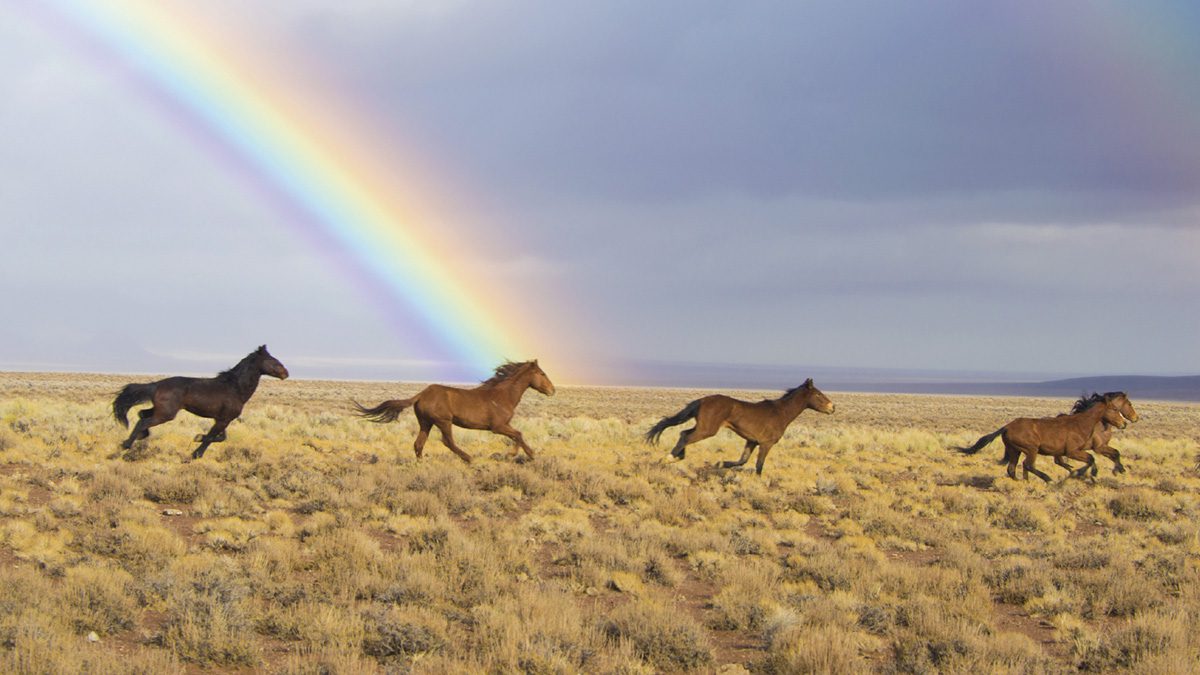
There are now more American mustangs in captivity than roaming free.
More than 75,000 wild horses currently live in Bureau of Land Management holding facilities, with another 20,000 added each year. These overcrowded pens cost taxpayers billions over the horses’ lifetimes. Only a fraction are successfully adopted—and many of those eventually reappear at low-end auctions, slipping quietly into the slaughter pipeline once federal protections are lost after titling. Similar removals conducted by the Bureau of Land Management and the United States Forest Service, as well as roundups on tribal lands, often result in horses being sold for shockingly low prices, with inconsistent oversight and limited long-term safeguards.
Helicopter roundups—justified as necessary population control—frequently cause physical injuries, broken family bands, and lasting psychological trauma. Critics argue that the narrative of “overpopulation” ignores a larger truth: cattle grazing, mining, and commercial interests often exert far greater strain on fragile Western ecosystems. Ranchers pay heavily subsidized fees to graze livestock on public lands, while wild horses are blamed for degradation and removed—sometimes clearing the way for expanded industrial use. Once displaced, many mustangs move through auctions and kill pens before being transported across borders to Canada or Mexico for slaughter.
The mustang—an enduring symbol of liberty and resilience—has become a captive of policy.
But there is another story unfolding.
Kourtney Hardy, founder of Nirvana Mustang Sanctuary, first fell in love with wild horses after watching Spirit: Stallion of the Cimarron as a child. What began as fascination evolved into calling. During a moment of meditation years later, the word “Nirvana” surfaced—a vision of sacred refuge for the soul of the American West.
In 2021, she and her husband purchased land near the San Juan Mountains, laying the foundation for a sanctuary devoted to rescuing mustangs from the slaughter pipeline. By 2024, they relocated to northeast Texas, where Nirvana now spans 3,000 acres near Texarkana and is home to more than 300 rescued wild horses.
Here, the story changes.
Piper arrived skeletal and hollow-eyed, a casualty of neglect. Today, she grazes lush native pasture, vibrant and curious, bonded to her herd. Harmony came in terrified and wounded—pregnant with a mule foal, Sonata, whom rescuers did not yet know existed. Now mother and daughter frolic together in safety. Smokey, once subdued by fear-based training, has rediscovered calm confidence among trusted companions.
Their transformations are not anomalies. They are proof of what dignity can restore.
Founded as a Christian organization, Nirvana Mustang Sanctuary, home to over 300 rescued American mustangs, views each horse as a living creation worthy of protection and reverence. The mission extends beyond rescue. Through advocacy and education, Hardy works to illuminate the realities of federal land management and inspire alternatives rooted in responsible stewardship rather than removal.
The long-term vision is audacious: expand to more than 20,000 acres and provide lifelong refuge to thousands of mustangs who would otherwise face uncertain and often tragic ends. Supported by a growing national network of donors and advocates, the sanctuary represents both protest and promise—a declaration that America’s wild horses deserve more than confinement.
The mustang once carried pioneers across uncharted terrain. Today, it carries a question for us: Will we allow the embodiment of American freedom to disappear behind fences and feedlots—or will we fight for a future where wild still means wild?
At Nirvana, freedom is not a memory.
It is being rebuilt, one rescued life at a time.
You can help write the next chapter—donate today to give a mustang the chance to run free, heal, and thrive.