
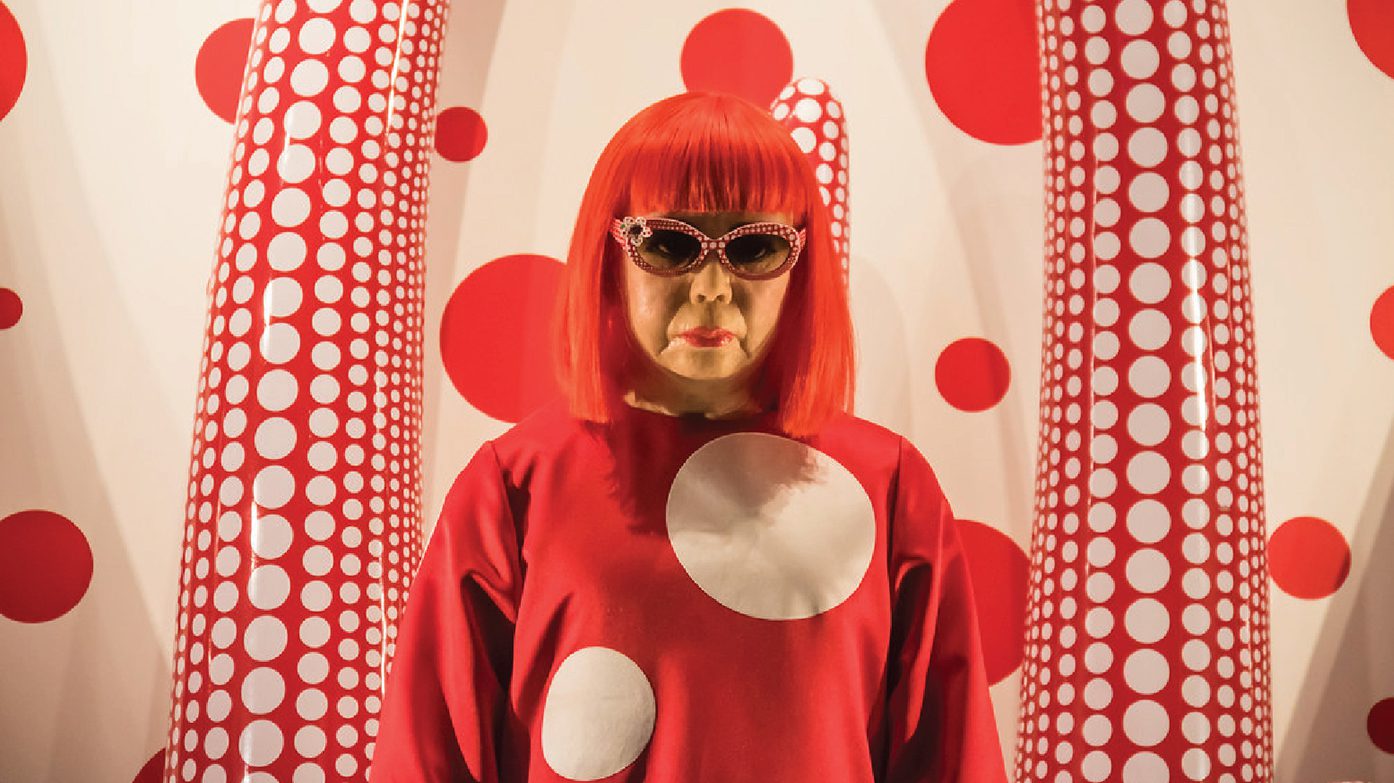
With her signature polka dots unfolding across canvas, sculpture, and immersive infinity rooms, Yayoi Kusama continues to redefine what it means to experience art. In 2023, she ascended to the apex of the contemporary art world—profiting more at auction than any peer, even David Hockney—proving that her singular vision is every bit as commercially potent as it is culturally iconic. According to the Hiscox Artist Top 100 report, works by Kusama generated roughly USD 80.9 million at auction in 2023, catapulting her past David Hockney’s approximately USD 50.3 million total. This puts her firmly at the top of the contemporary market for that year. Her commercial success is not a flash in the pan: her artworks have maintained strong performance in secondary markets over years. Her average sale price for editions, prints, and works across categories has ranged around USD 244,638, with many lots selling for far less and blockbuster works pushing the ceiling ever higher. In the print market specifically, the average sales price has persistently hovered above £22,000 in recent years. Meanwhile, her top-tier works—large-scale paintings, rare infinite-net canvases, or major installations—have broken multi‑million‑dollar records. Thus, acquiring a midlevel Kusama, such as a signed print or small-scale work, might still require a six-figure investment, while marquee pieces often demand high-seven or eight figures—if they even come to market.
Born in 1929 in Matsumoto, Japan, Kusama grew up on a plant nursery and seed farm, where repetitive motifs and natural forms stirred her early imagination. From an early age she reported visual hallucinations of dots and nets—sensory experiences she translated into art as a means of survival and transcendence. In 1957 she relocated to New York, arriving with little but hundreds of paintings and silkscreen experiments. There, she quickly inserted herself into the avant-garde circles of the 1960s, intersecting with Pop art, Fluxus, and minimalism—but always on her own terms. Among her early breakthroughs was Phalli’s Field (1965), an installation of red polka-dotted sculptural forms in mirrored space. Over ensuing decades, her practice expanded organically: infinite-mirror rooms, soft sculptures, pumpkins, polka-dot rooms, performance, writing, fashion, and beyond. Her rise in the market was gradual rather than meteoric—but it was persistent. Because she continued producing and controlling her estate via the Yayoi Kusama Foundation, her works have remained relatively rare, carefully managed, and thus highly desirable. Her practice’s consistency over decades gives collectors confidence: here is a living legend whose output and cultural presence remain strong.
For those seeking to engage with Kusama’s work in situ, there is no shortage of opportunities. Current exhibitions include a retrospective that is slated to open at Fondation Beyeler in Basel in October 2025, then travel to Museum Ludwig in Cologne and finally Stedelijk in Amsterdam. At the Fondation Louis Vuitton, an exhibition titled “Yayoi Kusama: Infinity” unites works from her earliest New York years through her most recent immersive rooms. In Denmark, the Louisiana Museum continues to display Gleaming Lights of the Souls, one of her signature mirror-infinity installations. These exhibitions not only bring Kusama’s vision directly to audiences, but also often drive fresh demand in the secondary market around their openings.
If you aspire to own a Kusama, several pathways exist, though each demands care, expertise, and patience. Primary-market galleries that hold relationships with the Yayoi Kusama Foundation may provide first access to small editions or works directly from the studio. The secondary market, including high-profile auction houses such as Christie’s, Sotheby’s, and Phillips, regularly offers Kusama lots, particularly in Hong Kong or New York. Many blue-chip galleries and art advisory firms also offer discreet, curated placements and private sales for Kusama works. Occasionally, museums or foundations will commission or acquire works and then match buyers or patrons in collaboration with the artist’s estate. A collector should engage a trusted art advisor or specialist, perform due diligence on provenance and condition, and be prepared for limited supply and rigorous authentication protocols. Kusama’s dominance in 2023 underscores that she is no longer just a cult favorite: she is a market mover, a brand, and a force of cultural gravity. To own a Kusama today is to hold a piece of art history in constant motion—and that is precisely what makes her a luxury asset in the truest sense.