
Paris Fashion Week’s Most Radical Trend Wasn’t Fashion—It Was Age

May 11, 2026

Paris Fashion Week has long dictated what the world learns to desire next. But this season, the most disruptive statement wasn’t a silhouette, a fabric innovation, or even a viral debut. It was time—visible, unfiltered, and deliberately unedited.

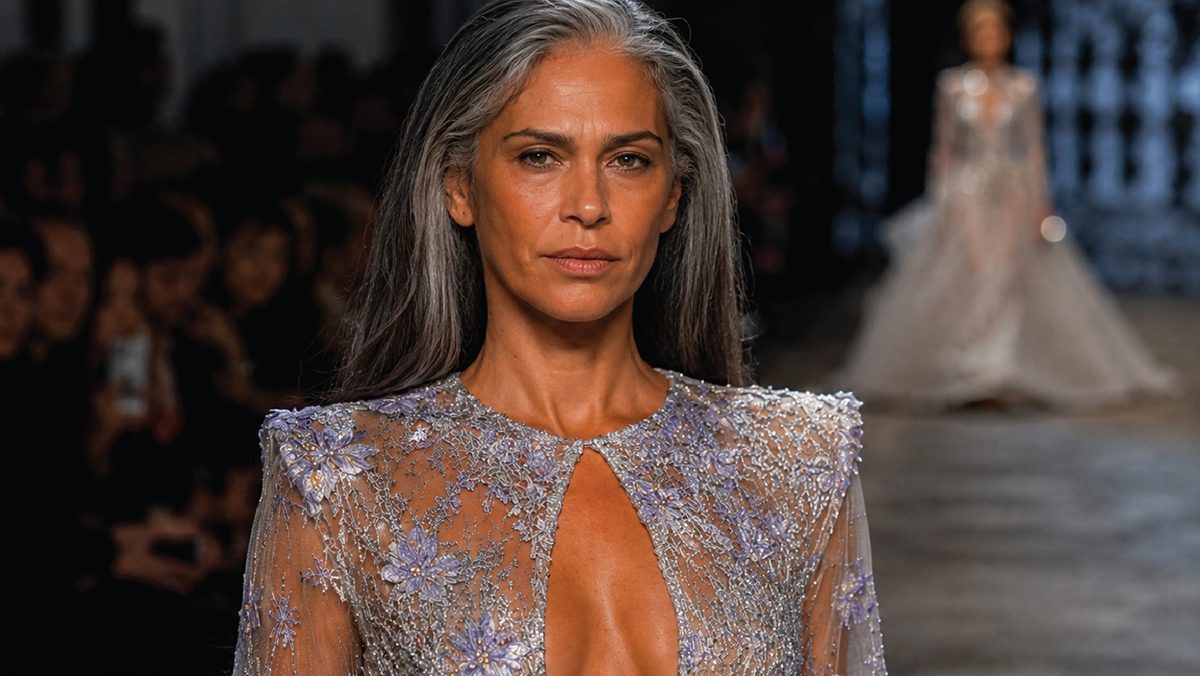
Across several runways, a quiet but unmistakable shift unfolded: models with gray hair, softening skin, and expressive, unhidden laugh lines moved through collections once again signaling aspiration. In an industry historically defined by the pursuit of perpetual 25, this felt less like casting evolution and more like cultural correction.

For decades, luxury fashion sold an idea of suspension—of age, consequence, and even identity. Faces were polished into uniformity, texture erased in favor of digital smoothness, and youth positioned as the only legitimate visual language of value. But at this year’s Paris Fashion Week, that visual language fractured.

What emerged instead was a new aesthetic code: age-transcendent beauty. Not “anti-aging,” not “aging gracefully,” but something more assertive—aging visibly, intentionally, and without apology. The runway became a space where lived experience was not edited out, but elevated as a form of distinction.

Designers leaned into this shift with quiet confidence. Garments were still sculptural, conceptual, and meticulously constructed, but they were no longer dependent on the illusion of uniform youth to complete the narrative. Instead, contrast did the work. A silver strand catching the light beneath a sharply tailored collar. A deeply lined smile reframing the softness of a silk gown. Skin that told a story rather than hiding one.

The effect was not nostalgic—it was radical. Because what Paris is beginning to signal is not a return to “natural beauty,” but a redefinition of what luxury itself looks like in a post-perfection era.

In this emerging framework, time is no longer treated as something to conceal or correct. It becomes a marker of presence, access, and even privilege. To age visibly and still occupy space in fashion’s most scrutinized environments is to reject the long-standing requirement of invisibility that has shaped beauty standards for generations.

This shift also reflects a broader cultural recalibration. Across wellness, beauty, and fashion, consumers are increasingly skeptical of engineered perfection. The polished, airbrushed ideal no longer reads as aspirational—it reads as distant. In its place, authenticity has become the new currency, and with it, a more complex definition of desirability is taking hold.

At Paris Fashion Week, that complexity was on full display. A model’s gray hair was no longer a detail to be softened backstage. It was part of the look. A face marked by time did not detract from luxury—it deepened it. The message was subtle, but unmistakable: beauty is no longer about resisting time, but about embodying it.

What makes this moment particularly powerful is not just what is being shown, but what is being unlearned. The idea that youth is synonymous with value is no longer unchallenged. In its place, a quieter, more enduring form of status is emerging—one rooted in authenticity, visibility, and the confidence to be fully seen.

If fashion has always been a mirror of cultural desire, then this season’s reflection is clear. The future of luxury is not ageless because it denies age. It is ageless because it no longer fears it.

This website uses cookies to improve your experience. We'll assume you're ok with this, but you can opt-out if you wish. Accept Read More

Privacy & Cookies Policy