
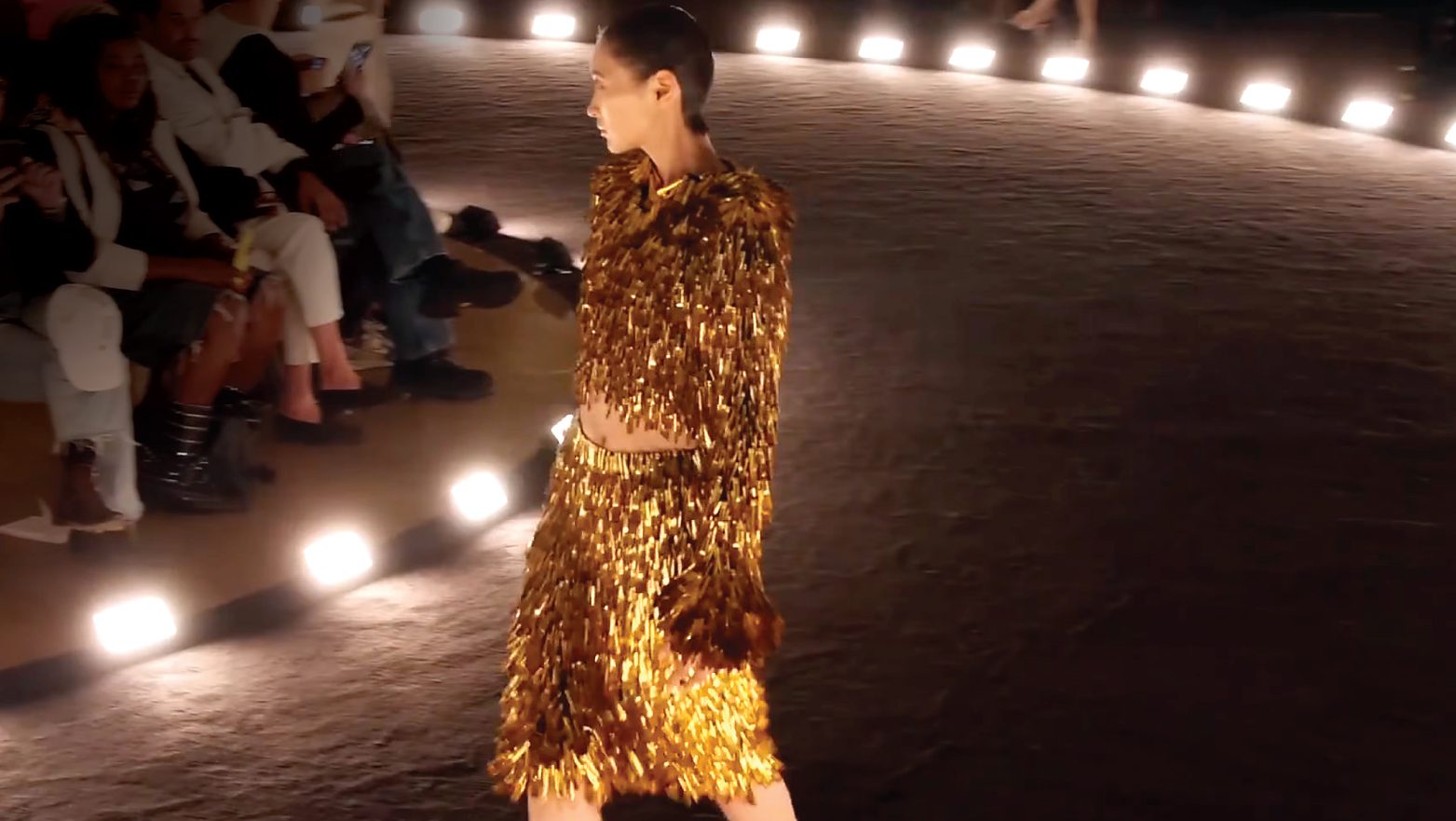
The Schiaparelli Dress Made of 6,000 Paintbrushes at Paris Fashion Week

March 16, 2026

At Paris Fashion Week Spring/Summer 2026, Daniel Roseberry staged a show for Schiaparelli that felt less like a runway and more like a gallery opening. Presented inside the modernist halls of the Centre Pompidou, the collection—titled Dancer in the Dark—explored the enduring relationship between fashion and art, a dialogue that has defined the house since its founding nearly a century ago.

Dress detail

Among the evening’s most unforgettable creations was a sculptural dress constructed from approximately 6,000 paintbrushes, transforming a tool of artistic expression into couture itself. The piece shimmered under the lights like a kinetic sculpture, its dense forest of bristles catching movement and shadow with each step. In a collection preoccupied with the tension between discipline and imagination, the dress functioned as both garment and manifesto: fashion not merely inspired by art, but built from it.

The idea would have delighted the house’s founder, Elsa Schiaparelli. Born in Rome in 1890, Schiaparelli revolutionized twentieth-century fashion by merging avant-garde art with clothing. Her collaborations with surrealist artists—most famously Salvador Dalí—produced some of fashion history’s most iconic objects. The legendary Lobster Dress, the Tear Dress from the 1938 Circus collection, and perfume bottles shaped like a woman’s torso challenged the boundary between the wearable and the fantastical. Schiaparelli also introduced the shocking fuchsia hue known as “Shocking Pink,” a color so bold it became synonymous with her name.

Her work shocked the establishment because it refused to treat fashion as merely decorative. Instead, Schiaparelli approached clothing as a medium for wit, provocation, and artistic experimentation. Gloves sprouted claws, jackets bore anatomical motifs, and garments referenced surrealist paintings. In doing so, she pioneered a vision of fashion that blurred the line between couture and conceptual art—an ethos that still defines the maison today.

Roseberry’s Dancer in the Dark collection made that lineage explicit. Presented in a gallery once home to a major Brancusi retrospective, the show intentionally framed fashion as cultural artifact rather than fleeting spectacle. Models moved through the space in sharp tailoring, fluid column gowns, and trompe-l’oeil knits that echoed Schiaparelli’s historic fascination with illusion and anatomy. The palette—primarily black, bone white, and crimson—heightened the sense of drama, allowing sculptural details to take center stage.

Within that theatrical environment, the paintbrush dress emerged as the show’s most literal fusion of art and couture. Thousands of brushes—objects usually hidden in a painter’s studio—became a shimmering textile. The result was at once extravagant and playful, embodying the irreverent spirit that made Schiaparelli a revolutionary figure in fashion history.

Nearly a century after Elsa Schiaparelli first collaborated with Dalí, her influence remains unmistakable. Under Roseberry’s direction, the house continues to produce garments that behave like sculptures, ideas, and provocations all at once. The paintbrush dress, like the surrealist masterpieces that inspired it, invites viewers to reconsider what fashion can be: not just clothing, but a living work of art. Watch the full show here.

This website uses cookies to improve your experience. We'll assume you're ok with this, but you can opt-out if you wish. Accept Read More

Privacy & Cookies Policy