
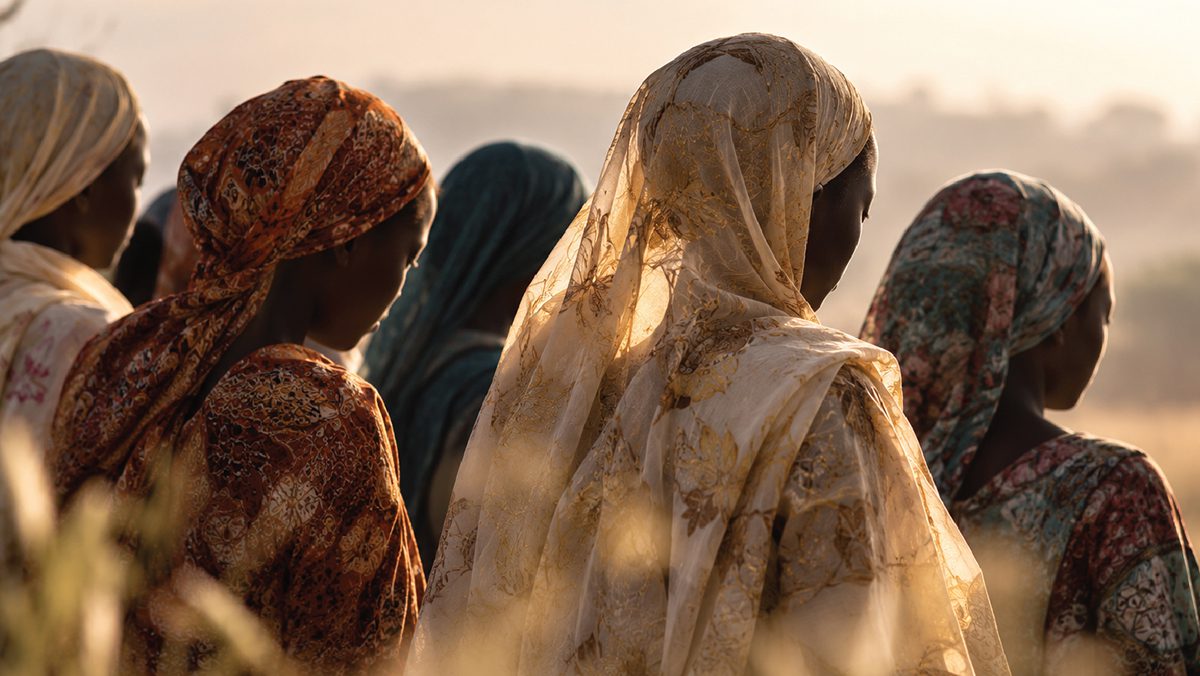
Some works of art are beautiful. Others stay with us because of the story they refuse to let us forget.
As ELYSIAN’s Art Subject Matter Expert and owner of EVEY Gallery & Art Foundation, Carla Groh has spent her career immersed in the artists, ideas and movements that shape our cultural conversation. It was through her discerning eye that ELYSIAN was introduced to Argentine artist Marta Estrems and to one extraordinary painting born from a story that reached across continents and into the lives of hundreds of young women.
For Estrems, painting is less about capturing what can be seen than giving form to what cannot: emotion, connection and the intangible experiences that bind us to one another. Her ethereal abstract canvases bridge our inner and outer worlds, and her creative process is rooted in contemplation—a willingness to quiet external noise and become receptive to emotions that may be painful, chaotic or difficult to express.
That philosophy takes on particular weight in N.274, a work Estrems created in response to the 2014 abduction of schoolgirls in Chibok, Nigeria.
On April 14, 2014, Boko Haram militants abducted 276 students from the Government Girls Secondary School in Chibok. The kidnapping horrified the world and helped ignite the international #BringBackOurGirls movement. Twelve years later, the story remains unresolved. In April 2026, the #BringBackOurGirls movement reported that 83 of the girls remained unaccounted for.
For Estrems, learning what had happened felt, in her words, like “274 thorns” lodged in her heart.
Her response was to paint.
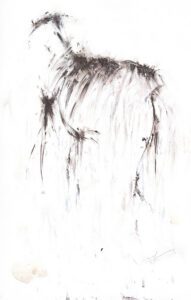
DC SERIES N274, mixed media on canvas, 2023 by Marta Estrems. Courtesy Evey Fine Art/Palm Beach/Artevey.com
According to the artist’s account, Estrems deliberately chose a large canvas for N.274 to symbolize the overwhelming imbalance of power at the heart of the story. Working with charcoal, oil, graphite and medium, she built the composition layer upon layer in a restrained, neutral palette. Light and darkness create depth and tension, while kinetic brushstrokes give physical expression to emotions that words struggle to contain.
Throughout the work, the number 274 appears repeatedly, woven among other symbols and adding to the painting’s dense emotional weight. Estrems describes that repetition as lending strength to the representation of the barbarism inflicted upon the young women.
It is a harrowing subject, but confronting difficult emotions rather than turning away from them is central to Estrems’ practice. Her paintings seek to transform the intangible into something visible—to create space for contemplation, connection and, ultimately, catharsis.
Born in Rosario, Argentina, in 1949, Estrems trained in Buenos Aires at the Manuel Belgrano National School of Fine Arts and the Prilidiano Pueyrredón National School of Fine Arts. She moved to the United States in 1987 and now lives and works in Miami. Her work has been exhibited in Argentina, Italy, Spain and the United States, including at the Armory Art Center, Nova Southeastern University’s Alvin Sherman Library and the Latino Art Museum.
Today, EVEY Gallery & Art Foundation features Estrems among artists whose work reflects its belief in art’s ability to shape cultural conversation.
N.274 is a poignant expression of that possibility. A painting cannot undo what happened in Chibok. It cannot return the missing girls to their families. But it can refuse to allow their story to disappear.
And sometimes, remembrance itself is an act of connection.