
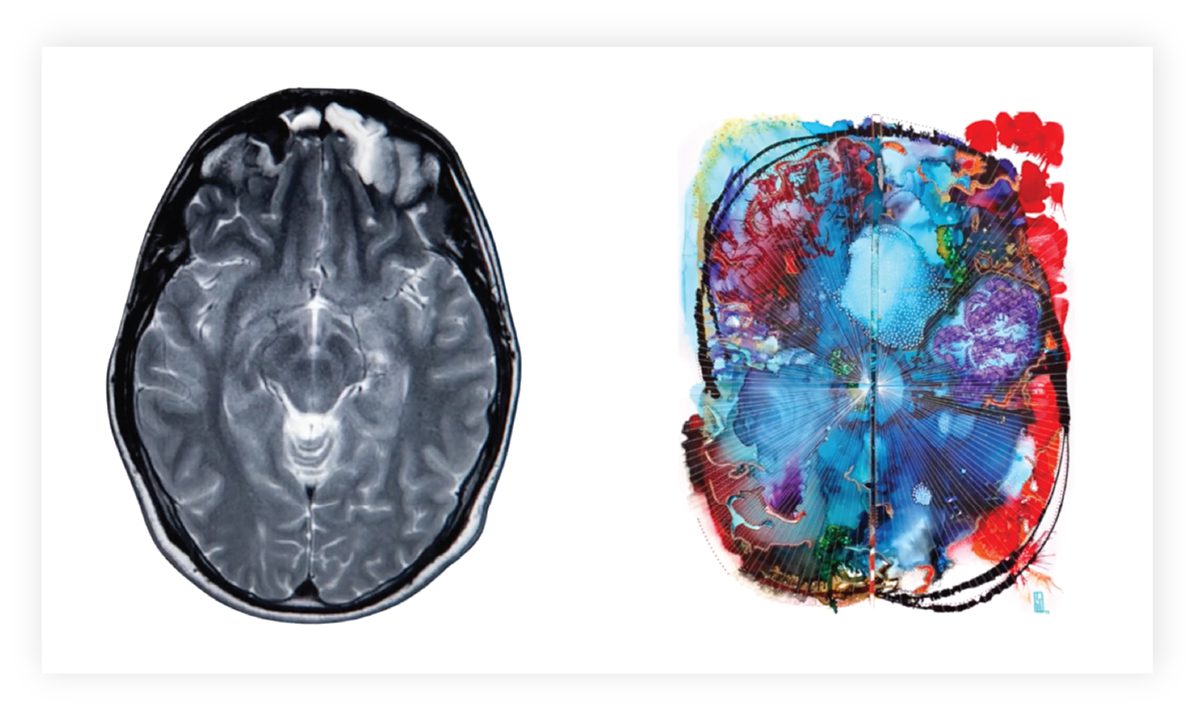
What if the image that frightened you most could become the most beautiful thing hanging on your wall?
For Oregon artist Lindsey Holcomb, that question is not metaphorical. It is the story of how a medical diagnosis changed her art, her career and the way hundreds of others saw their own bodies.
In 2017, at 35 and raising two young daughters, Holcomb was diagnosed with multiple sclerosis, a disease of the central nervous system. Seeing the MRI that helped confirm her diagnosis was frightening. The lesions represented uncertainty she could neither control nor fully understand.
So she painted it.
Holcomb had already returned to art as a way to cope with stress, anxiety and depression. After her diagnosis, she printed an image of her brain scan and created an abstract interpretation in vivid color. She has described that first work as something like a diary entry: a personal attempt to process what had happened. When it was finished, she felt better.
Then something unexpected happened. Holcomb shared the work online, the National Multiple Sclerosis Society amplified it, and people responded.
That response eventually became Colors of MS, the social art project Holcomb launched in 2019. By late 2025, she had transformed approximately 400 brain scans for people across the United States and 14 countries. Her subjects have included people living not only with MS but with neurological conditions including epilepsy, brain cancer and traumatic brain injury.
Video still: ArtLifting, Studio Stories: Lindsey Holcomb
The process is deeply personal. Holcomb talks with participants about their medical journeys and asks them to choose colors associated with feelings such as hope, peace or energy. Working with alcohol ink and mixed media, she studies the architecture of each scan. In some works, she cuts out the shapes of lesions with a wood-burning tool and traces them in gold—a reference to kintsugi, the Japanese tradition of repairing broken ceramics in a way that emphasizes rather than conceals their fractures. Thread from her late grandmother, who was a seamstress, has also appeared throughout her work.
That may explain why these pieces resonate so powerfully with the people who acquire them. They are not anonymous decorative abstractions. For MRI commissions, the collector’s own medical image and story become part of the artwork. One recipient featured by Oregon Public Broadcasting became emotional upon seeing hers, describing the experience as another step in her healing.
Holcomb’s reach now extends beyond personal commissions. Her work is represented by ArtLifting, has appeared in private collections internationally, and has been placed in corporate and residential environments including BlueRock Therapeutics’ Cambridge headquarters and a Greystar property in New York.
There is another reason her story matters now. MS continues to affect Holcomb’s vision, energy and fine-motor control, making the intricate MRI works increasingly demanding. She has begun limiting those commissions and exploring broader, freer abstractions her body can more comfortably create.
The illness changed what Holcomb could do. Instead of ending her creative life, it gave her a new visual language—and helped hundreds of people look at an image they once feared and see something entirely different.