
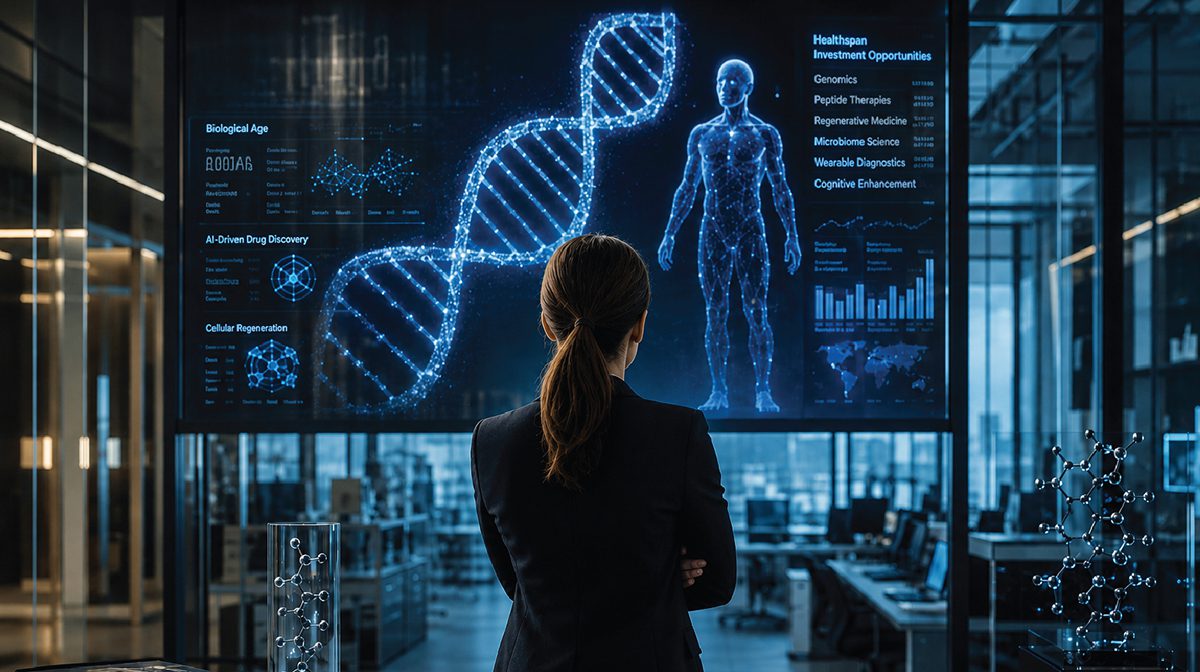
For most of modern history, aging was treated as inevitable—something to manage, not something to question. That assumption is now being challenged by one of the fastest-growing and most heavily funded sectors in global markets: longevity and healthspan investing, a field where biology, technology, and venture capital are converging in a billion-dollar race to redefine what it means to grow old.
What was once dismissed as wellness optimism has evolved into a serious capital category attracting hedge funds, biotech giants, sovereign wealth funds, and Silicon Valley investors. The premise is no longer simply to extend life, but to extend healthy life—compressing illness into the final years and keeping people biologically younger for longer. In financial terms, the opportunity is staggering. In scientific terms, it is still unfolding.
At the center of this movement is a wave of companies working on biological age reversal—attempting to slow, halt, or even partially rewind cellular aging processes. These firms are exploring everything from epigenetic reprogramming to senescent cell clearance, targeting the biological mechanisms that cause decline rather than the symptoms themselves. Alongside them, peptide therapies and regenerative medicine startups are pushing treatments designed to repair tissues, restore organ function, and enhance resilience at the cellular level.
Artificial intelligence has accelerated this race dramatically. AI-driven drug discovery platforms are compressing timelines that once took decades into years or even months, scanning vast biological datasets to identify compounds that may influence aging pathways. Investors see this as a turning point: aging is no longer just a biological process, but a data problem that can be modeled, simulated, and potentially optimized.
Meanwhile, microbiome science is revealing that longevity may be influenced as much by gut ecosystems as by genetics. Startups in this space are developing personalized interventions aimed at reshaping microbial balance to improve immunity, metabolism, and even cognitive function. Wearable diagnostics are adding another layer, turning everyday devices into continuous health monitors capable of tracking biomarkers in real time, shifting healthcare from reactive treatment to predictive prevention.
Perhaps the most ambitious frontier is cognitive enhancement. As populations age but remain active in the workforce and consumer economy, demand is rising for solutions that preserve memory, focus, and mental agility. From neurotech devices to pharmacological interventions, companies are racing to keep the aging brain not just functioning, but thriving.
What makes this sector especially powerful is not just the science—it is the macroeconomic shift beneath it. Aging populations are no longer seen purely as a cost burden on healthcare systems, but as an extended consumer base with decades of potential economic activity ahead. If healthspan can be meaningfully extended, entire industries—from real estate and travel to finance and retail—could be reshaped by longer, more active life cycles.
This is why some investors are beginning to describe longevity as a potential trillion-dollar economy. It sits at the intersection of healthcare, technology, and consumer behavior, with implications that stretch far beyond medicine. It touches retirement, productivity, workforce participation, and even the definition of life stages themselves.
Yet alongside the optimism lies a deeper set of questions. If aging becomes something that can be slowed or managed, who will have access? Will longevity become another form of inequality, available first to those with capital and connections? And as science edges closer to intervening in the biology of aging itself, society is being forced to confront a question it has long avoided: is the goal simply to live longer, or to live differently?
In the end, the longevity revolution is not just about extending lifespan. It is about redefining the timeline of human potential—and rewriting the economics of time itself.