

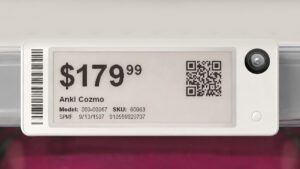
Smart Digital Price Tag
The next time you pause in front of a product, you may not just be deciding whether to buy it—you may already be part of the data being collected about your hesitation. Across major retail environments, a new generation of “smart” digital price tags and shelf systems is quietly being deployed, equipped with tiny cameras, motion sensors, and AI-driven analytics designed to observe shoppers in real time. What once was a passive aisle is becoming an active intelligence system, capable of recording how long a customer lingers, which products draw attention, and what ultimately influences the decision to buy—or walk away.
On the surface, the technology is framed as efficiency. Retailers argue that these systems help optimize inventory, reduce waste, and tailor in-store experiences to consumer behavior. But behind the language of optimization lies something far more complex: behavioral surveillance embedded directly into the shopping environment. These smart shelves don’t just measure sales—they measure hesitation, curiosity, and preference, turning human micro-moments into actionable data streams.
In some implementations, AI-powered sensors can map movement patterns across aisles, identifying which displays attract attention and which go unnoticed. Advanced systems are even being tested with facial recognition capabilities, raising the possibility that individual shoppers could be tracked across visits. While companies often emphasize anonymization, critics warn that de-identified data can still be remarkably revealing when combined with purchase history, loyalty programs, and mobile device signals.
The implications extend well beyond the physical store. Experts in digital privacy caution that this kind of behavioral data does not remain confined to the aisle where it is collected. Instead, it becomes part of a broader data ecosystem that follows consumers into online advertising networks, recommendation engines, and dynamic pricing systems. A moment of hesitation in front of a product could influence the ads a person sees later that day, the prices they are offered, or even the products that are subtly prioritized in their digital feeds.
This convergence of physical and digital surveillance marks a turning point in retail strategy. The store is no longer just a point of sale—it is a data collection engine feeding continuous feedback loops. Every glance becomes a signal. Every pause becomes a prediction. And every decision becomes training data for systems designed to anticipate the next one.
Supporters of the technology argue that this is simply the natural evolution of retail in an age defined by personalization. Just as online platforms track clicks and scrolls, physical stores are now catching up, creating a seamless understanding of consumer behavior across environments. In their view, smarter shelves lead to better stocking decisions, fewer empty aisles, and more relevant product offerings.
But the discomfort surrounding the technology is not just about data collection—it is about asymmetry. Shoppers rarely opt into this level of observation in any meaningful way, and even fewer fully understand the extent to which their in-store behavior is being analyzed. The experience of browsing, once private in its subtlety, is becoming legible to systems that never forget, never blink, and continuously learn.
As retail environments become increasingly intelligent, the question is no longer whether the shelf is watching—but what it does with what it sees. In a world where attention is currency, even hesitation has value. And as that value is captured, analyzed, and sold, the boundary between observation and influence grows thinner with every aisle walked.