
As America reflects on 250 years of independence, the nation rightly honors the people who have worn its uniform. Yet woven through that history is a quieter lineage of service—one that never appeared on rosters or stood at attention, but walked on four legs beside soldiers through mud, smoke, and uncertainty. For more than a century, military working dogs have stood at the edge of danger, not for recognition or reward, but because their unwavering bond with their handlers demanded nothing less than courage.
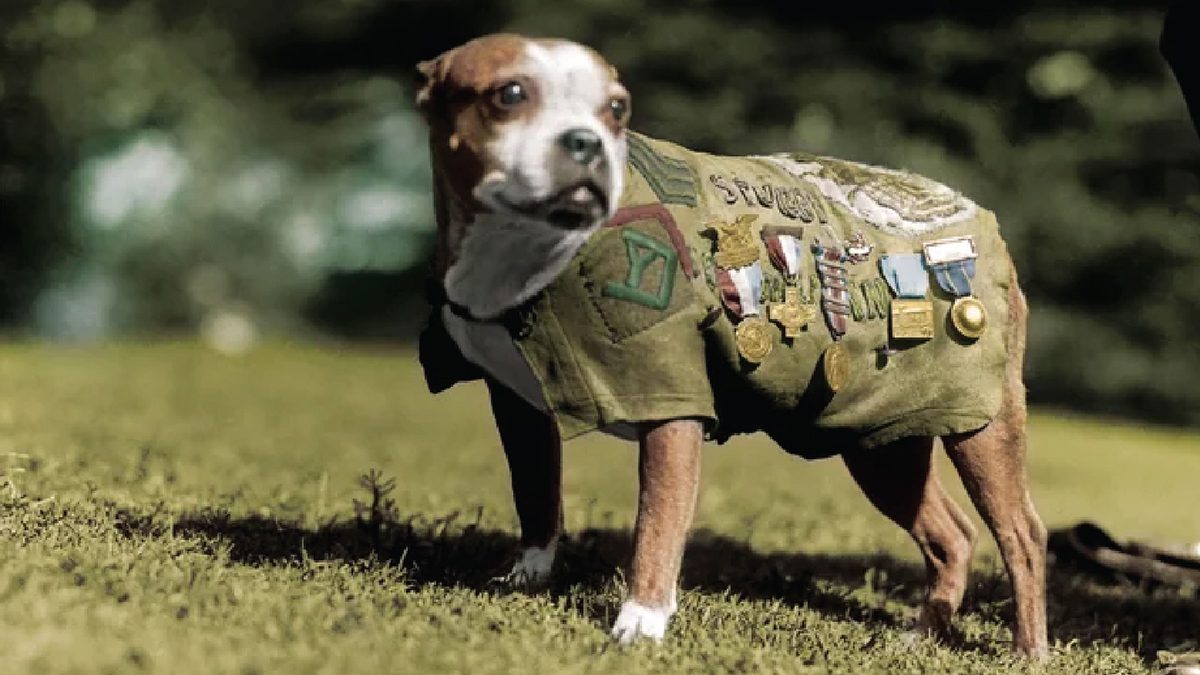
One of the earliest and most enduring examples is Sergeant Stubby, a stray-turned-regimental mascot who became one of World War I’s most unlikely veterans. Serving with the 102nd Infantry Regiment on the Western Front, Stubby participated in 17 battles and developed an uncanny ability to anticipate danger. He alerted troops to incoming artillery before the human ear could register it, detected the presence of poison gas, and even helped locate wounded soldiers amid the chaos of no-man’s-land. His instincts saved lives in ways that formal training could not replicate. By war’s end, Stubby had become a decorated symbol of loyalty and resilience, proving that devotion does not require language or rank—only trust.
Decades later, during World War II, another canine would etch his name into military lore: Chips of the U.S. Army’s 3rd Infantry Division. In the invasion of Sicily in 1943, Chips and his handler were caught in a brutal firefight when he suddenly broke free and charged toward an enemy machine-gun nest. The suddenness of his assault disrupted the position, forcing Italian soldiers to surrender and allowing American troops to advance. Though injured in the engagement, Chips continued to serve across multiple theaters of war in North Africa and Europe, repeatedly demonstrating courage under fire. His actions earned him several military decorations, though debates over animal eligibility briefly clouded official recognition.
Yet beyond the battlefield achievements lies something more enduring: a reminder of what loyalty looks like when stripped of ideology, rank, or expectation. Military working dogs do not understand nations or narratives. They understand proximity, command, and trust. That simplicity is precisely what makes their service so profound. They move forward when asked, stay when others might flee, and often place themselves in harm’s way without hesitation. In doing so, they reflect a form of heroism that is instinctive rather than calculated.
As the United States commemorates 250 years of independence, these stories ask us to widen the lens through which we view service and sacrifice. The nation’s history is not written solely by those who sign enlistment papers or stand on podiums. It is also shaped by those who cannot speak of duty, yet embody it fully. In remembering Chips, Stubby, and countless unnamed companions, we are reminded that courage often arrives quietly, moves quickly, and leaves no demand for credit. Some of the greatest patriots in American history never asked to be called patriots at all.
In an era that often celebrates visibility, their legacy endures precisely because it resists it. The paw prints they left behind are not just traces of history, but invitations—to consider courage as something quieter, deeper, and more instinctive than applause. Long after battles fade from memory, their example continues to teach what steadfast loyalty truly means.