
In an era when headlines often reduce complex nations to political sound bites, literature offers something far richer: context. Through memoir and personal narrative, books illuminate the traditions, struggles, and human experiences that shape a society in ways news reports rarely can.
Iran is perhaps one of the clearest examples. While international coverage often focuses on the country’s theocratic government, many Iranians, particularly among younger generations, are highly educated and culturally engaged, and many have expressed strong aspirations for greater personal and political freedoms. Many also continue to engage with Western literature, music, film, fashion, and technology despite decades of political tension between Iran and Western governments. Beneath the political narratives lies a nation with a rich literary tradition, vibrant artistic heritage, and countless personal stories that rarely make international headlines. One remarkable memoir offers an intimate window into these realities by revealing not only the challenges faced by ordinary Iranians, but also the resilience, faith, and hope that endure despite them.
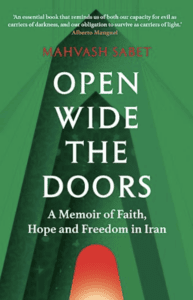 Open Wide the Doors: A Memoir of Faith, Hope and Freedom in Iran by Mahvash Sabet is a profoundly moving account of courage in the face of persecution. An acclaimed poet, educator, and member of Iran’s persecuted Bahá’í community, Sabet chronicles the early months of her imprisonment after being detained on charges that international human rights organizations have widely described as stemming from her Bahá’í faith and community leadership. Through vivid reflections on solitary confinement, relentless interrogations, and the quiet acts of kindness that sustained her, she transforms unimaginable hardship into a powerful meditation on dignity, forgiveness, and the enduring strength of the human spirit.
What makes Sabet’s memoir particularly compelling is its refusal to surrender to bitterness. Although she recounts the harsh realities of incarceration, including isolation, uncertainty, and the emotional toll of injustice, her narrative remains grounded in compassion rather than vengeance. Poetry, memory, and faith become lifelines that allow her to preserve her identity in circumstances designed to strip it away. Her reflections reveal how hope can survive even in the darkest environments, not through denial of suffering, but through an unwavering commitment to humanity.
Far more than a prison memoir, Open Wide the Doors offers readers a deeply personal perspective on contemporary Iran through the eyes of a woman whose compassion remained intact despite extraordinary injustice. Rather than allowing oppression to define her story, Sabet reveals how faith, hope, and moral conviction can become acts of quiet resistance. Her experiences also illuminate the broader challenges faced by Iran’s Bahá’í community, whose members have endured decades of discrimination, imprisonment, and restrictions on education and employment because of their religious beliefs.
At the same time, the memoir reminds readers that one person’s experience can reveal dimensions of Iranian society that are often absent from political coverage. Throughout her story, Sabet reflects on moments of unexpected kindness from fellow prisoners and ordinary individuals, demonstrating that empathy and solidarity can endure even under authoritarian rule. These deeply human interactions illustrate the complexity of Iranian society as experienced through Sabet’s own story, offering a perspective that extends beyond political rhetoric.
For readers seeking to better understand Iran beyond headlines and ideological divides, this memoir provides an unforgettable place to begin. Rather than offering abstract political analysis, it invites readers into one woman’s lived experience, allowing history and current events to be understood through the lens of personal testimony. The result is an account that feels both deeply intimate and universally relevant.
Great literature does more than explain history; it invites us to experience it through another person’s eyes. Mahvash Sabet’s memoir replaces distance with empathy, offering a rare glimpse into the humanity that persists even under oppression. It reminds us that behind every geopolitical conflict are individuals who continue to love, create, hope, and persevere despite extraordinary obstacles. In an increasingly polarized world, Open Wide the Doors stands as a powerful testament to the resilience of the human spirit and a compelling reminder that genuine understanding begins not with politics, but with listening to another person’s story.