To be human is to stare into the abyss of mortality and ask what lies beyond—and no civilization answered that eternal question with more cultural fervor than Ancient Egypt. But one would be wrong to assume the Ancient Egyptians did not value life equally; in fact, to them, life and death were mythically connected through the union of the sun god Ra and the god of the underworld, Osiris.
For the Egyptians, life was the utmost sacred force, given to us by the sun god who renewed creation each day. To be alive was to have this divine force coursing through us, and to go through the cycle of life and death meant to participate in cosmic theology.
The Ancient Egyptians saw death as the ultimate mystery and the final initiation into the deepest secrets of existence, but also as a dimensional shift, a powerful transformation, disintegration, judgment, and passage into a different realm of existence.
In order to get to the other side, the afterlife, and eventually paradise (the Field of Reeds), one had to traverse dangerous spiritual terrain, one had to transform completely in many stages, stand trial, and pass tests and gateways to emerge triumphant on the other side and be able to “come forth” from the tomb and wander the earthly realm as pure spirit.
The Book of the Dead was not an actual Book
All of the powerful magic spells needed to accomplish this were encoded in the Book of the Dead, which was not, essentially, a book of the dead, but a compilation of spells to aid the immortal soul. It was written in a language steeped in barely comprehensible symbolism, aiming to transform the remnants of our human metaphysical parts into a higher form of being, an Akh, that could roam freely through the world of the living and the underworld.
It is important to know that they (the spells) weren’t canonized in this form (‘The Book of the Dead’) until the New Kingdom and that they performed a very specific function for the deceased (unlike the other Ancient Egyptian Books of the Afterlife, which describe the journey of the sun and the underworld itself in great details).
They protect the heart of the deceased, animate the ushabti (funerary figurines designed to act as magical servants), enable transformations, provide nourishment, secure entry through gates, reunite the ba (soul-aspect) with the mummy in the tomb, and equip the deceased for the Judgment of the Dead.
The order and number of spells contained in the Book of the Dead changed overtime, and individual manuscripts also varied greatly in length, differing with each surviving papyrus.
Reading the Book of the Dead
Imagine standing before a 2,000-year-old papyrus containing humanities hopes for eternal life and being able to read it. But anyone, layman or academic, who has ever tried to read the Book of the Dead without the help of secondary texts, probably had an experience somewhere on the spectrum of mild bewilderment to total confusion. And this is no surprise, since this corpus of funerary spells, whose earliest sources reach back to the pyramid texts, was never composed to be ‘read’ but to be ‘used’ in a similar fashion as a custom-written toolkit for a very specific purpose: To return to the world after death in a specific form, or to put it in Ancient Egyptian terms, to ‘go forth by day’.
To understand how to read it, we must also keep in mind that each spell-book—and this is what the ‘book of the dead’ really was, a custom made compilation of spells—worked within the framework of Ancient Egyptian mortuary belief system, in which the deceased went on a perilous quest of transformation, liberation and reunion of their soul(s’) parts into a form that could live on a different plane of existence altogether while simultaneously enjoying worldy pleasures on the earthly plane and spiritual paradise, which might sound antithetical to us but posed no contradiction to the Ancient Egyptians (a common theme in a culture where several things could be true at once).
‘Going Forth by Day’, the original title of this spell compilation, known as ‘The Book of the Dead’, reveals the intricacies of what is sought to be achieved here: The return of the soul to the grave and the reunification with the mummy to be able to roam the world by day as a so-called AKH, an effective spirit.
The Osiris Spell – Death as the Ultimate Mystery
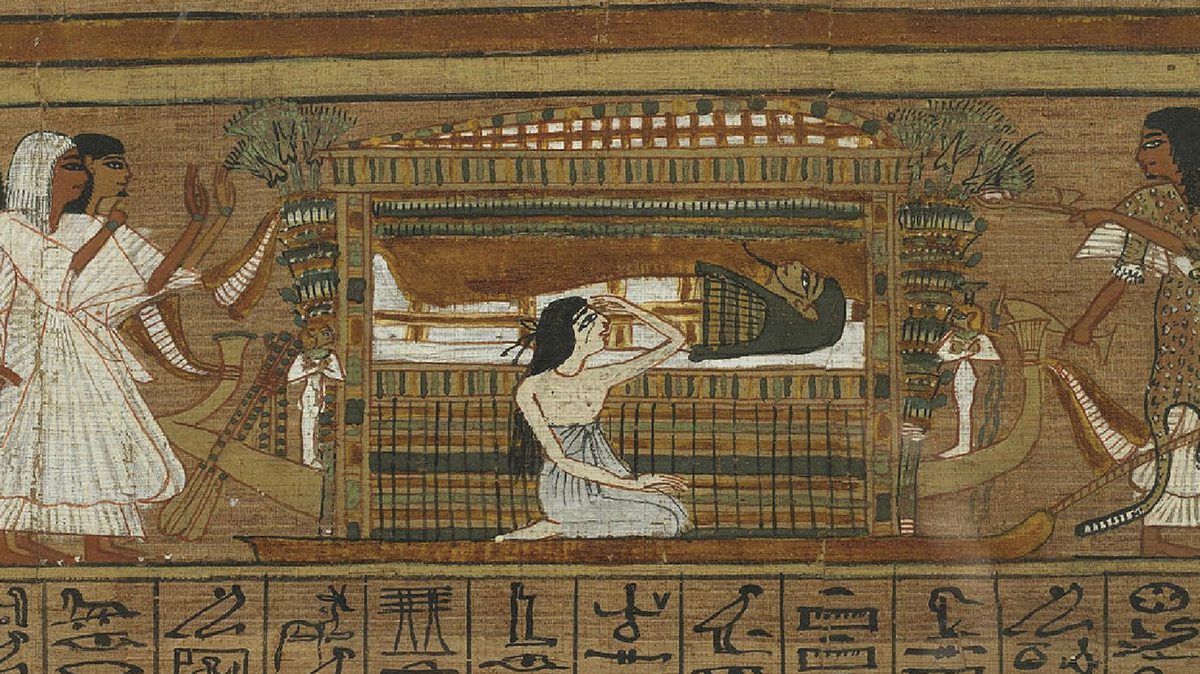
Image pictured above: ‘Book of the Dead’, Papyrus of Ani (sheet 5): The Funeral Procession: this sheet shows Ani’s funeral procession as it moves toward his tomb, where it will be met by grieving women and where the coffin will be stood erect for the last rites and the widow’s last farewell before being taken into its final resting place.

He who divulges it dies a sudden death, for it is a great mystery:
It is Re and it is Osiris.
Re sets in the western mountain and lights the netherworld with his rays. This means: Re rests in Osiris; Osiris rests in Re.
OSIRIS SPELL 1
The first spell in the Book of the Dead states the greatest mystery of all, the mystery of Osiris, which is considered the foundational myth of Ancient Egypt and served as the cornerstone for Egyptian conceptions of kingship, death, resurrection, and cosmic order (Ma’at). It also reveals the hidden regenerative core of reality in Ancient Egyptian mysticism. The Ancient Egyptians believed that every night, the sun god Re traveled through the underworld. At the “sixth hour”(midnight), Re would land upon and unite with the mummified body of Osiris (“Re rests in Osiris, Osiris rests in Re”). This reunion formed the regenerative core of the cosmos, as Re received the regenerative power of Osiris to be reborn at dawn, while Osiris received the light and life-force of Re to remain “alive while dead”.
This union bridged the two most important dimensional and temporal spheres, where Re (Sun god/Life force) represented “Neheh” time, which was cyclical, moving, and actively evolving like the sun and seasons, and Osiris (God of theAfterlife / Fertility) represented “Djet” time, a suspended, static, and eternal state of being in the afterlife.
By declaring them united in efficacious speech (“one resting in the other”), life and death are no longer separate, but two parts of a single, perfect whole, forming the source for eternal life. Through this spell in the Book of the Dead, the deceased sought to inhabit this union, and just as Re united with Osiris to“become” a regenerated being, the human soul (Ba) sought to unite with its eternal body (symbolically tended to in the mummy) to live forever. Spell 1 recounts this mystery by serving as the ritual “transition” in which the deceased enters the afterlife and begins to identify with the combined power of Re and Osiris. It is here that the deceased magically assumes the identity of Osiris and is no longer addressed by their earthly name alone but is called “Osiris [N/insertName]”. This transformation is the first step in entering the “mystery,” as the individual takes on the form of the god who died and was reborn and begins the journey in the solar barque, representing this regenerative union since the“Osiris” (the deceased) is now physically located within the vessel of the sun god, Re, mirroring the nightly merging where Re enters the underworld to rejuvenate Osiris.
A core part of the “mystery” is the physical reconstitution of the mummified body so the soul can inhabit it, and Spell 1 provides the “words which bring about resurrection,” ensuring the body “shall endure in the netherworld” while the soul follows the daily path of the sun. All of this is designed to ensure that the individual can “go forth by day” and move freely between the realms of the living and the dead.
Death as a Triumph of Substance over Matter and a Dimensional Shift
To enter into the greatest mystery, according to the Ancient Egyptians, meant to partake in a dimensional shift, where the different temporal spheres collapsed onto each other, the “Djet” time, represented by Osiris, and the “Neheh” time, represented by the cycle of the sun’s renewal.
Arriving at the End of Time
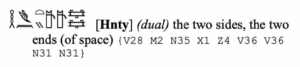
In Spell 15, the Sun-hymns, parts A–D, and Spell 17, we learn that in the last partof the journey through the afterlife, the souls of the dead arrive at the Khenty, the place where the “two ends of space” converge. Khenty is usually accompanied by the word for sky or eternity (Neheh) and translated as the “end of time” or “the end of eternity,” but when we look at the classifier (see pictured above at the end of the word), we see a hidden path 𓈐, actually two of them, leading out of the Duality.
These two “time dimensions” or eternities alongside the sun cosmology (invoked also through the mythical symbolism of the sun barque the soul traveled on) formed the bedrock of Ancient Egyptian cosmology, but also constitute one of the key elements of eternal life and the necessary shift from one plane of existence to the other.
To take the path out of the duality of time that leads to eternity, our soul—our Ba—has to travel to the horizon𓈌, which is another metaphorical word for dying (see pictured below) and exit the duality of Djet (virtual or suspended eternity) and Neheh (cyclical time) to enter the liminal realm of the Khenty where both these temporal dimensions are suspended.

The overlapping of these layered temporal dimensions, which interface for the infusion of life and the quality of “becoming” Kheper (HPR) written with the Scarab hieroglyph, a state of changing manifestations, or going through different states (Kheperu, pl.), which is only inherent in this cyclical time dimension, allows for a unique glimpse into the underlying principles of Ancient Egyptian metaphysical thought.
The logical consequence of these two different states of being is that the soul can only achieve eternal (atemporal) life after “death,” which is nothing but a state of disintegration upon leaving this temporal plane of expansive “becoming” (allowing us to develop by inhabiting different states of being, which an atemporal plane cannot) for a different form of existence, the spells affording the deceased the tools needed to cross the barrier that leads beyond material existence and linear time.
For the Ancient Egyptians, death was therefore not the negation of life, but the point at which its deepest structure was finally revealed. The Book of the Dead offered the deceased a ritual technology for crossing beyond fragmentation, material limitation, and temporal duality into a regenerated state of being. To “go forth by day” was ultimately to emerge from death not as the person one had been, but as an akh: an effective, transfigured spirit capable of participating eternally in the hidden union of Re and Osiris.
Want to learn more? Carla is teaching a course that will include e-books and 6 lessons on how to read hieroglyphs, the Book of the Dead, and the meaning of life in Ancient Egypt. Click here for more information.