

Maxed-out credit cards. A car sold to keep a business alive. A bet on an idea that had yet to prove itself. For Allison Ellsworth, these were not the details of a billion-dollar success story. They were the price of pursuing a possibility she could see before the market did.
In 2015, Ellsworth began experimenting in her kitchen with apple cider vinegar, fruit and sparkling water. Her ambition was deceptively simple: reimagine soda for consumers reconsidering what they drink, without asking them to give up the pleasure of drinking it. She saw an opportunity in an industry where familiar formulas had long defined the category.
Together with her husband, Stephen, she invested approximately $90,000 of their own money in the venture during its first year. They maxed out credit cards, sold a car to help fund the business and opened their own manufacturing facility. The financial risk was significant, particularly as they prepared to welcome their first child. Her husband initially thought committing fully to the business was crazy. He trusted her vision anyway.
Originally called Mother Beverage, the company began attracting customers at farmers’ markets. Within 18 months, it had generated $500,000 in revenue, according to Fortune’s reporting on Ellsworth’s account. In 2018, the couple appeared on Shark Tank, where investor Rohan Oza agreed to invest $400,000 for a 25% stake. The company subsequently rebranded as Poppi.
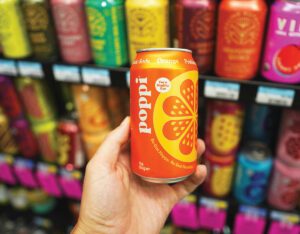 The breakthrough was not simply creating another beverage. Poppi recognized that consumers did not necessarily want to abandon soda. They wanted a different relationship with it. By combining prebiotic ingredients with fruit-forward flavors, relatively low sugar and colorful packaging, the brand positioned itself at the intersection of everyday enjoyment and changing wellness preferences. Its social media strategy helped make the cans recognizable and culturally relevant, particularly among younger consumers.
Ellsworth and her team were challenging the conventions of a category long dominated by familiar brands, offering a different vision of what soda could look like and how it could fit into contemporary lifestyles.
In May 2025, PepsiCo completed its acquisition of Poppi for a headline price of $1.95 billion. That figure included $300 million in anticipated cash tax benefits, bringing the net purchase price to $1.65 billion, plus a performance-based earnout tied to certain targets. In May 2026, Fortune reported that Ellsworth and her husband received more than $100 million from the sale. The headline valuation was not the amount the founders personally received.
Yet the most revealing part of Ellsworth’s story is not the final number. It is the uncertainty that came before it: making decisions without knowing whether they would pay off, finding customers before the brand was widely recognized and committing resources to an idea that still needed to prove itself.
Entrepreneurship is often celebrated in hindsight, when risk becomes a compelling origin story and uncertainty disappears beneath a valuation. Ellsworth’s experience offers a more nuanced lesson. Conviction may start a business, but execution, consumer understanding and adaptability are what turn an idea into a valuable enterprise.
A kitchen experiment became a nationally recognized brand, and a family’s calculated gamble became a life-changing exit. The lesson is not that every bold bet will succeed. It is that sometimes the most consequential opportunities emerge when someone questions what an established industry has stopped questioning.
For Ellsworth, the breakthrough was not inventing soda. It was seeing room to reinvent it.