
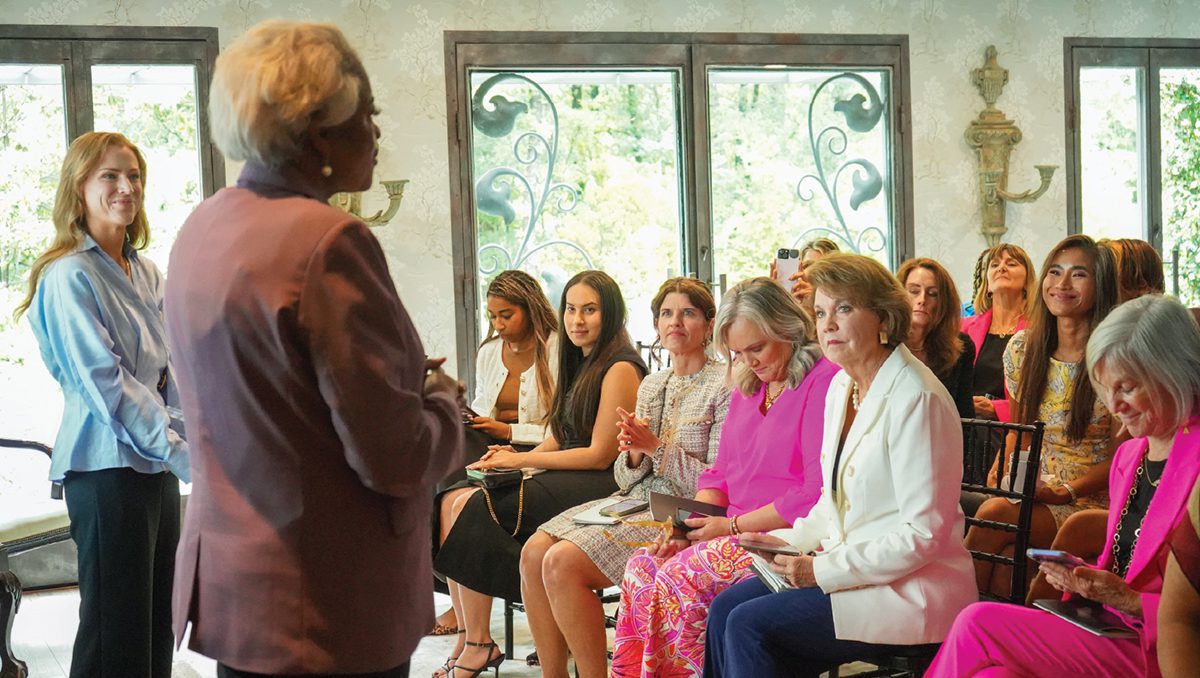
Long before the inaugural Red & Blue: Call for Humanity summit convened in Spartanburg, South Carolina, the work had already begun. What emerged publicly as a gathering of elected women and thought leaders was, in reality, the result of a carefully structured process rooted in political science, systems thinking, and participant-driven collaboration.
At its core, the summit was built around a central mission: creating a baseline of women working together—irrespective of political beliefs—for humanity and a purpose greater than self. The initiative was intentionally future-facing, grounded in research, focused on quantifiable outcomes, and designed to produce lasting impact rather than symbolic dialogue.
Unlike traditional conferences where programming is predetermined, the Call for Humanity summit was developed through an iterative, research-informed process facilitated by social scientists in coordination with ELYSIAN. The methodology reflected a key principle within political science and democratic theory: sustainable civic progress is most effective when participants help shape the agenda themselves.
The process began with broad, future-oriented questions designed to move beyond reactive politics and toward long-term societal challenges. Participants and advisors explored expansive themes connected to peace, justice, artificial intelligence, civic enterprise, arts and culture, education, health, and environmental responsibility. Rather than beginning with fixed ideological positions, organizers focused on identifying areas of shared concern and collective opportunity.
From there, topics were refined through a deliberate narrowing process. Ideas were evaluated against a rigorous framework: they needed to be nationally or generationally significant, future-focused, actionable, measurable, and proactive rather than reactive. The objective was not simply to discuss problems, but to identify areas where women leaders could create tangible progress over time.
The summit’s participant-led structure became one of its defining political innovations. Co-chairs Lara Trump and Donna Brazile were each asked to contribute broad, solution-oriented topics for consideration, reflecting differing political perspectives while reinforcing the summit’s commitment to cross-partisan engagement. These themes were then shared with attendees through the ELYSIAN Connect app, allowing participants to weigh in on the issues they felt most compelled to address before arriving in person.
This digital engagement phase represented an important element of modern political science practice: participatory agenda-setting. Rather than imposing conclusions from the top down, organizers created mechanisms for collective input, ensuring the summit’s priorities emerged organically from the lived experiences, leadership insights, and civic concerns of the women involved.
Through surveys and guided facilitation, participants were asked to define ideal outcomes, identify subtopics of interest, and articulate the greatest obstacles to meaningful progress. Ultimately, the collective process led participants toward a central summit focus: Peace & Justice, with a particular emphasis on the role of women in peacebuilding and conflict resolution.
This focus reflected growing international research demonstrating the importance of women’s inclusion in peace negotiations. Today, women remain significantly underrepresented in global peace processes. Yet studies consistently show that peace agreements involving women are more likely to be implemented and produce longer-lasting outcomes.
Participants also explored the systemic barriers preventing greater female participation in conflict resolution, including restrictive gender norms, economic inequality, threats and intimidation, unequal educational access, and underinvestment in women-led organizations. Rather than approaching these challenges symbolically, the summit framed them as actionable civic and leadership issues requiring long-term engagement.
Political strategists and advisors including Alex Garcia of AG 1 Consulting, Christiana Purves Lance of The Laurens Group, and Antjuan Seawright and Andrea McCoy of Blueprint Strategy LLC contributed guidance throughout the process, helping foster outreach, engagement, and strategic collaboration. Camille Sachs also provided political science insights that informed the summit’s overall development and structure.
By the time participants gathered in person, the summit had already evolved into something far deeper than a traditional political convening. It became a living framework for collaborative leadership—one designed not merely to react to polarization, but to proactively cultivate dialogue, accountability, and measurable civic progress over the next five years.