
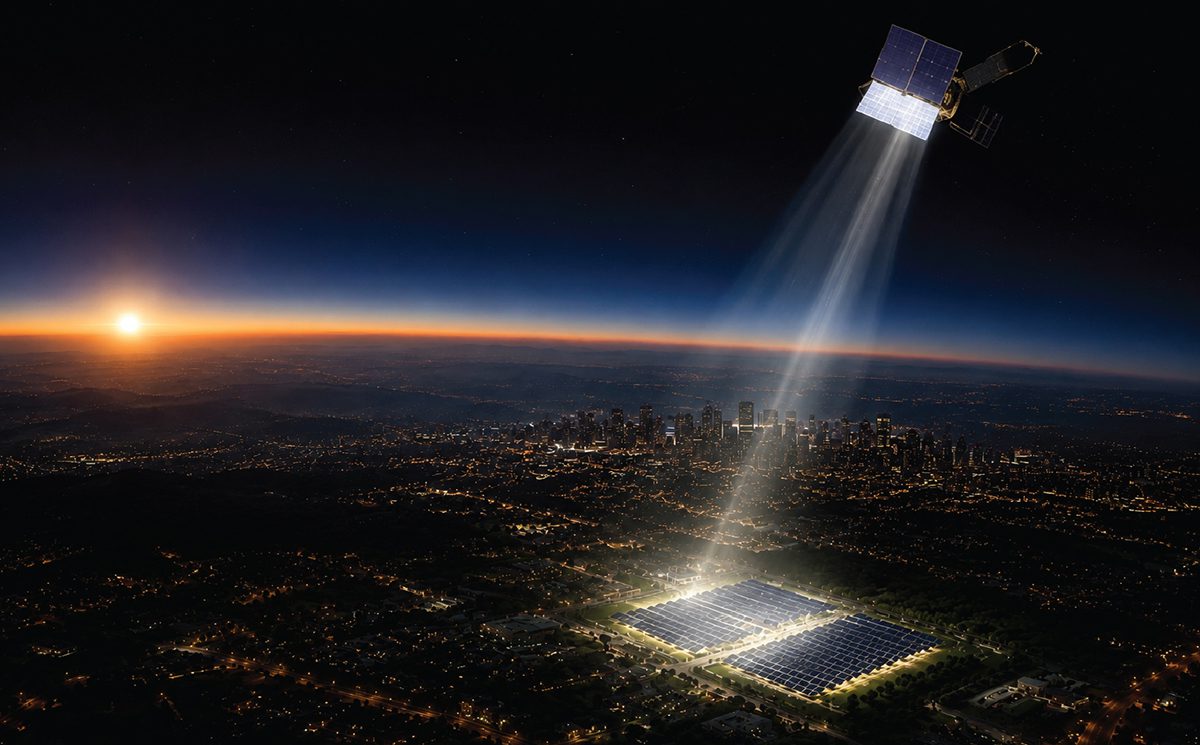
What if nightfall was no longer final, but optional? A California startup called Reflect Orbital is attempting to challenge one of the most fundamental rhythms of life itself by engineering what it calls “sunlight on demand.” The company is developing a constellation of space-based mirrors designed to reflect sunlight back to Earth after sunset, effectively extending daylight for solar farms, cities, events, and even disaster zones through a simple app-based request system.
At its core, the idea is deceptively simple: capture and redirect sunlight from orbit to targeted areas on Earth, creating controlled bursts of illumination long after the natural sun has set. In practice, however, it represents a radical rethinking of energy, infrastructure, and even the boundaries between natural and manufactured environments. If successful, Reflect Orbital could transform nighttime from a fixed biological and cultural constant into a flexible, programmable resource.
The company’s pitch is especially compelling in the context of renewable energy. Solar power, while rapidly expanding, is fundamentally limited by daylight hours. By extending usable sunlight beyond sunset, Reflect Orbital argues it could dramatically increase the efficiency of solar farms and reduce dependence on fossil-fuel-based backup systems. In disaster zones, the technology could provide critical lighting for emergency response, search operations, and medical care when traditional infrastructure has failed.
But the implications go far beyond energy optimization. The ability to “order daylight” raises profound questions about control over natural systems. Critics warn that large-scale space mirrors could disrupt ecosystems, interfere with astronomical observation, and create unintended environmental consequences that are difficult to model from the ground. Others question whether concentrated control over light itself could deepen existing inequalities, with wealthier regions or corporations gaining privileged access to extended daylight while others remain in darkness.
Even more controversial is the philosophical shift embedded in the concept. For millennia, the setting sun has marked a universal boundary — between work and rest, visibility and obscurity, activity and stillness. Reflect Orbital’s vision effectively dissolves that boundary, replacing it with something dynamic, programmable, and potentially commercialized. In this model, daylight becomes not just a condition of nature, but a managed service.
Supporters see this as the next logical step in humanity’s long history of reshaping the environment to meet its needs. Just as electricity extended productivity beyond natural light and satellites redefined communication, space-based illumination could represent another leap in infrastructure abstraction — one where Earth’s most basic cycles become adjustable inputs in a technological system.
Yet the tension surrounding the project is precisely what makes it emblematic of a larger moment in innovation. Across industries, from artificial intelligence to climate engineering, the line between solution and disruption is becoming increasingly difficult to define. Technologies are no longer simply tools layered onto the world; they are beginning to reshape the conditions of the world itself.
Reflect Orbital sits directly at that intersection. It is at once a vision of radical efficiency and a source of unease about unintended consequences. It promises more control over nature than ever before, while forcing a question society has only begun to confront: just because we can extend daylight, should we?
In that tension lies the story — not just of one startup, but of an era where even the most ancient certainties are becoming subject to redesign.