
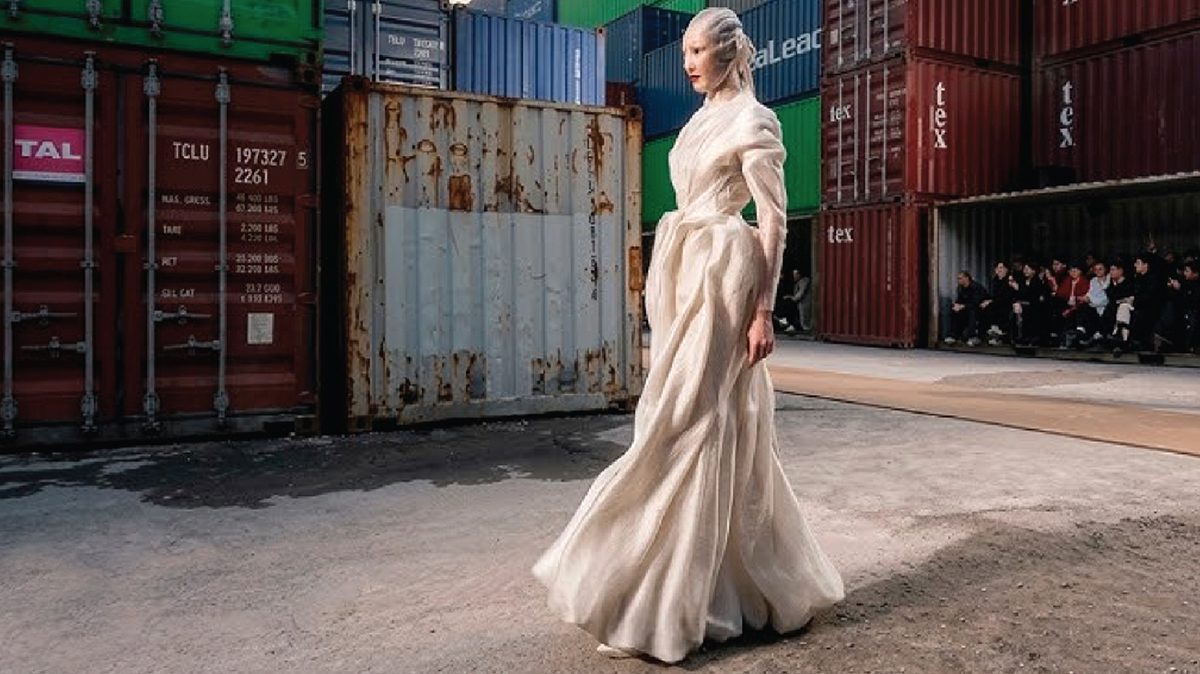
Maison Margiela’s Fall/Winter 2026 presentation doesn’t just challenge what a fashion show looks like—it challenges where fashion is even allowed to happen. Staged not in Paris, but inside a working shipyard in Shanghai, the collection unfolds in a landscape of stacked cargo containers, industrial cranes, and concrete ground that feels closer to a film set than a traditional runway. The effect is immediate: fashion is no longer framed as a seasonal unveiling, but as something immersive, architectural, and alive within a larger global system.
Under the direction of Glenn Martens, the house merges its ready-to-wear and Artisanal lines into a single continuous narrative, dissolving the usual hierarchy between couture craftsmanship and everyday tailoring. Instead of a linear catwalk, guests move through a constructed environment where models appear like figures inside an evolving industrial tableau. According to the brand, this is the first time Maison Margiela has presented a full show outside of Paris, signaling a deliberate shift in how and where the house chooses to tell its story.
The shipyard setting is not incidental—it becomes part of the language of the collection. The tension between softness and structure, fragility and weight, is amplified by the surroundings. Clothing that references thrifted materials, repurposed textiles, and deconstructed silhouettes feels even more radical against a backdrop of steel and machinery. What might normally read as conceptual fashion instead becomes environmental storytelling: garments echo the industrial textures around them, as if both were built from the same material logic.
Rather than presenting a collection to be consumed in a single glance, the show operates like a sequence of scenes. Masks obscure identity almost entirely on many of the models, erasing the face as a focal point and shifting attention toward posture, movement, and silhouette. Even when glimpses of skin appear, they feel intentionally withheld, reinforcing the idea that individuality is secondary to the overall composition of the world being built.
The models themselves move in a way that resists conventional runway polish. Their walk is slightly jerky, at times almost unsettling—less a glide than a series of deliberate, segmented motions. There is a controlled dissonance to it, as if the human body has been subtly recalibrated to match the mechanical rhythm of the shipyard around it. The effect is disorienting, blurring the line between performance and something closer to programmed choreography.
Layered textures—waxed surfaces, fragmented porcelain effects, reconstructed fabrics—turn each look into a standalone installation. The audience isn’t simply watching a runway; they are navigating a world where fashion, architecture, and performance merge.
This shift also reflects a broader transformation in luxury presentation. Brands are increasingly moving away from static runway formats toward experiential, location-driven storytelling that expands beyond Paris, Milan, or New York. In Shanghai, Margiela positions itself within a global cultural exchange, suggesting that the future of avant-garde fashion may no longer be tied to a single fashion capital.
What emerges is not just a collection, but a statement about scale. Fashion is no longer confined to clothing or even to bodies—it is becoming environmental, cinematic, and spatial. The shipyard is not a backdrop; it is part of the argument. And in that sense, the show doesn’t simply present clothes. It constructs a world.
Watch the full show here.